4-Dimethylaminopyridine, often shortened to DMAP, found its place in organic laboratories in the mid-twentieth century. Before its widespread use, chemists looking to push acylation and alkylation reactions forward had fewer choices. The story of DMAP is one of trial by experiment—scientists produced it while tinkering with pyridine derivatives, figuring out ways to speed up reactions that used to crawl. In the 1960s and 1970s, academic groups dug deep into heterocyclic chemistry, and the right mixture of curiosity and need birthed a catalyst that didn’t just speed reactions, but also made them cleaner and more predictable. Today, DMAP’s legacy carries through patents, textbooks, and lab protocols worldwide, all because a few persistent minds pursued better chemical tools.
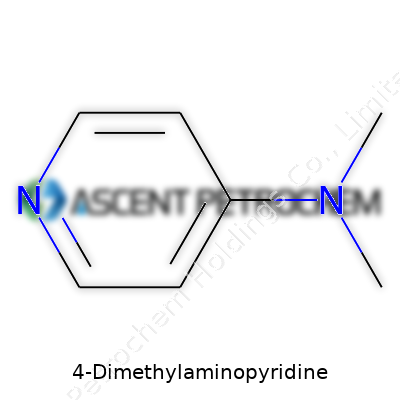
DMAP is a fine, white to light yellow crystalline powder with a faint, amine-like odor that sticks around when opened in a poorly ventilated room. Its structure owes itself to a pyridine core substituted at the four position with a dimethylamino group, which dialed up its electron density and brought about the catalytic magic. In the eyes of a chemist, DMAP stands out as the go-to nucleophilic catalyst for transforming carboxylic acids into esters and amides. Laboratories and manufacturing plants don’t just keep DMAP for a rainy day—its performance and reliability keep it in active rotation for essential processes.
Chemists trust what they can measure. Pure DMAP melts at 110–112°C, which matters for those handling it on a heat block or in a drying oven. It dissolves well in organic solvents like dichloromethane and ether, not so much in water. This makes it easy to work with in a wide array of synthetic procedures. Its basicity (pKa ≈ 9.7 for the conjugate acid) stands higher than the parent pyridine, thanks to that dimethylamino group that stabilizes charge and makes it a punchy nucleophile. In everyday storage, DMAP keeps well in sealed containers, facing down routine humidity without caking or decomposing.
Anyone who’s ordered DMAP in bulk expects clear labeling: content percentage, moisture, melting range, and residual solvents get spelled out, because no one wants to risk an expensive reaction on subpar chemicals. Industrial-grade material meets strict thresholds on impurities and particle size for even distribution in reactors. Suppliers label containers with hazard codes and handling precautions, which adds a layer of user safety. Chemists combine technical sheets with experience—testing small batches and running melting point checks when new shipments arrive—because trust in quality control isn’t built overnight.
Manufacturing DMAP typically starts with 4-chloropyridine or pyridine-4-carboxaldehyde. The process hinges on nucleophilic aromatic substitution or reductive amination, adding two methyl groups at the nitrogen on the pyridine ring. The chemists overseeing these steps know the need for pure starting materials since contamination trashes yields and creates headaches in purification. Many commercial routes envelop the intermediate in acid-wash steps or crystallize it from a suitable solvent, squeezing out impurities and prepping the catalyst for industry or research. Tinkering with reaction times, types of reductants, and isolation tricks often makes a difference on the plant floor.
DMAP packs a punch when added to acylation reactions. It speeds up the conversion, nudging acyl groups onto alcohols, amines, and phenols far better than plain pyridine. In peptide synthesis, DMAP stands behind the scenes, making sure the coupling goes off cleanly. Its catalytic action plays out through donating lone pair electrons, creating adducts that make sluggish intermediates far more reactive. Some chemists also modify DMAP itself: adding bulkier groups for selectivity, tweaking the electronic profile to tune selectivity or boost turnover. It’s tough to find a synthetic chemist’s toolbox without a jar of DMAP in some form or fashion.
Beyond “4-Dimethylaminopyridine,” you’ll hear it called DMAP in labs or 4-(Dimethylamino)pyridine on shipping manifests. Fewer people call it N,N-Dimethyl-4-aminopyridine, but the name crops up in regulatory documents and safety data. Across markets, product codes reflect purity or application—pharmaceutical grade, technical grade, or research-only grade. Brands vary by continent, with some regions using local nomenclatures or catalog numbers based on supplier networks. The names change, but the demand for consistent, reliable material remains the same no matter where it ships.
Handling DMAP means keeping health and environmental safety in focus. It’s an irritant—gets in the eyes, it burns, and contact with skin or lungs can leave a chemist with rashes or coughing fits. Personal protective equipment takes center stage: gloves, eye protection, and fume hood operation lay the groundwork for responsible use. Waste streams containing DMAP require chemical treatment or incineration, especially since regulations around nitrogenous bases tighten every year. Training goes hand in hand with written MSDS guidelines. New team members learn from supervisors, not just paperwork, since one slip-up with a strong base causes problems beyond simple cleanup.
DMAP found a home in pharmaceutical manufacturing, helping to build ester and amide bonds that wind up in drug molecules. It also plays a supporting role in agrochemicals, fragrances, and specialty polymers. Some specialty coatings and adhesives use DMAP-catalyzed reactions for improved bond strength or durability. Experienced chemists know its value extends to academic research, where new synthetic routes and target molecules demand speed and selectivity that older reagents can’t always deliver. Its utility proves itself every time a reaction once thought sluggish turns fast and productive with a pinch of DMAP.
Academic and industrial chemists push the boundaries by tweaking DMAP derivatives or searching for entirely new catalysts. Their papers explore faster reactions, higher selectivity, or methods that lower environmental impact. Some groups chase ways to recycle DMAP or recover it from waste streams without fancy equipment, saving money and reducing pollution. Conferences bring labs together to swap stories—what worked, what failed, what showed promise after an unexpected observation. This continuous cycle of experiment and feedback keeps DMAP chemistry alive, nimble, and up-to-date in a world that never stands still.
DMAP’s safety profile attracts close attention from toxicologists. Inhalation and skin contact cause acute irritation, and chronic exposure at high levels leads to serious health impacts in animal studies. Regulatory agencies established workplace limits and call for careful monitoring, especially during large-scale manufacture. Disposal guidelines grew stricter as evidence of aquatic toxicity emerged. Laboratories conduct regular air sampling, and plant operators install advanced ventilation and scrubber systems. The literature keeps growing on metabolic pathways and environmental breakdown, which serves both regulatory needs and community health.
Green chemistry and sustainability drive the search for efficient, recoverable catalysts. DMAP stands tested and true, yet researchers look to renewable routes for its production or biodegradable analogues for sensitive applications. Companies investing in process intensification want catalysts that perform at low concentrations and can be recycled easily. Environmental pressures mean new generations of DMAP-like molecules with even less ecological footprint could show up in future plant practices. The foundational chemistry remains, but demand for innovation, worker safety, and resource conservation reshapes how the industry thinks about this household catalyst.
Chemists who work with organic synthesis often reach for a jar of DMAP. It takes small quantities to make big changes in a reaction. DMAP acts as a catalyst, which means it helps other chemicals react together, especially in cases that would otherwise drag on for hours or days. For anyone spending long evenings in a laboratory—grad students, postdocs, industry researchers—speeding up a reaction with DMAP can mean the difference between being stuck babysitting glassware all night and heading home before dinner.
DMAP carries a nitrogen atom in just the right spot, making it very good at sharing electrons. This quality lets DMAP enable reactions such as acylation, where it pokes other substances (like acid anhydrides or acid chlorides) to react faster with alcohols and amines. There’s a classic example called the Steglich esterification. Without DMAP, this reaction might not finish by the end of a shift. With DMAP, what could take hours wraps up in less than one.
The chemicals made using DMAP end up in much more than a chemist’s notebook. Drug manufacturing often uses DMAP to create key ingredients for pharmaceuticals. Making a targeted pain reliever, a cancer drug, or even an antibiotic relies on building blocks that come from precision chemical reactions. In these cases, efficiency isn’t just about saving time, but about reducing the waste that can pile up from slower or less-selective chemistry.
Outside medicine, DMAP finds use in materials science. Specialty plastics and dyes trace their origins back to reactions sped up by DMAP. The influence stretches even further. Making fine flavors or fragrances, for instance, depends on creating molecules that only exist in tiny amounts in nature but can be synthesized with clean chemistry accelerated by DMAP.
Many organic chemists learn early that DMAP, despite its utility, brings risks. The same properties that make it an efficient catalyst also mean it can irritate eyes, skin, or lungs. Proper training matters. Even in a teaching lab, gloves and a fume hood aren’t optional. Responsible chemistry doesn’t cut corners on personal safety, especially with compounds like DMAP that enter water systems if not handled properly.
Waste management also deserves attention. Some facilities recover and recycle DMAP, while others neutralize and dispose of it. Research into greener alternatives continues. Younger chemists, in particular, often ask about less hazardous options. Plenty of academic journals now encourage authors to report on safer alternatives or use the smallest practical amount of DMAP to cut down on waste.
Studies into chemical processes keep searching for catalysts that deliver the advantages of DMAP—fast, specific, cost-effective—while producing fewer hazardous byproducts. The push for greener chemistry comes from both industry and academia. Some new catalysts might eventually replace DMAP for certain reactions. For now, DMAP stays in frequent use based on its proven track record, easy handling compared to stronger bases, and the trust earned over decades of practical results.
Working with chemicals like DMAP calls for more than just technical skill. Critical thinking, clear record-keeping, and respect for the risks—these habits protect both researchers and the environment, all while keeping progress in drug discovery and materials science moving forward.
Science often feels complicated until you strip molecules down to their essentials. 4-Dimethylaminopyridine, or DMAP, is one of those chemicals that looks modest on paper but has an outsized impact in laboratories. Its backbone is the pyridine ring, a six-membered ring with five carbon atoms and one nitrogen atom. Picture benzene, but swap out one of the carbons for a nitrogen. That single change gives pyridine its basic, slightly fishy smell, and rewires how it behaves among all sorts of other chemicals.
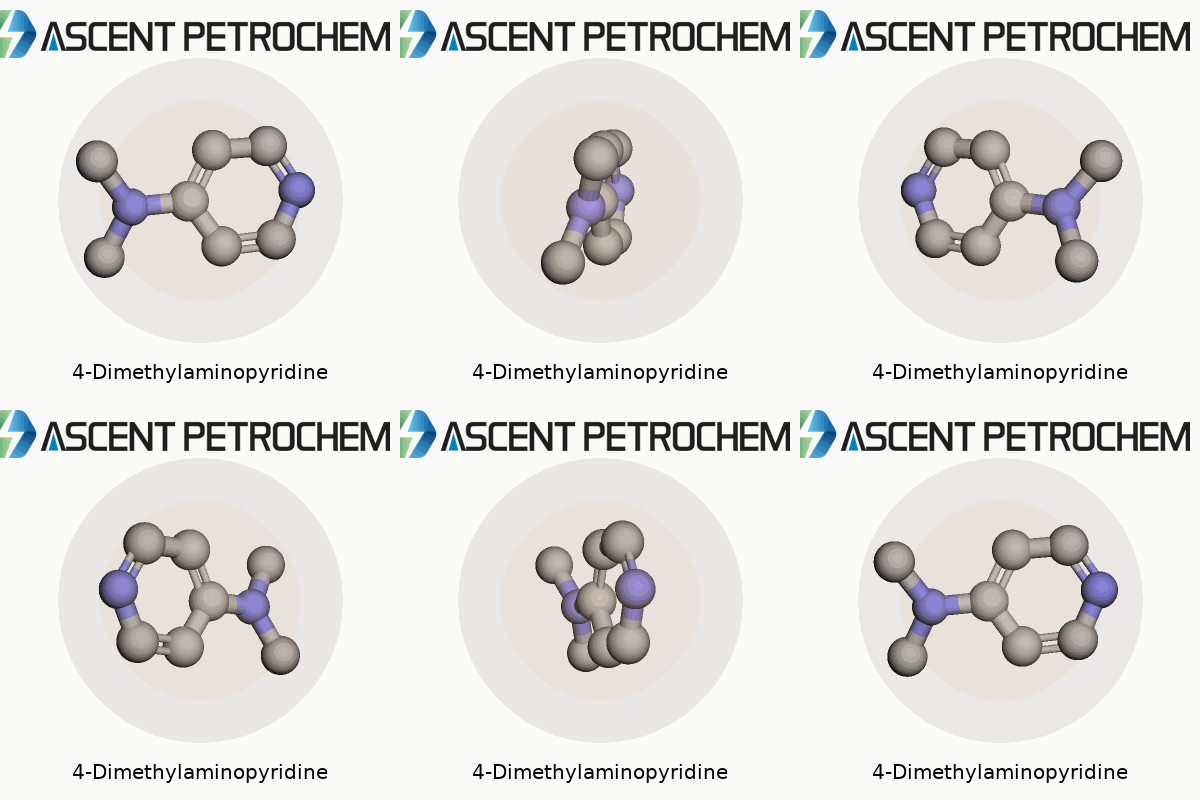
DMAP distinguishes itself from plain pyridine thanks to a special group glued to the ring. At the fourth spot on this ring, opposite the nitrogen, chemists attached a dimethylamino group. Imagine an amino group, which means a nitrogen atom linked to two hydrogen atoms. In DMAP, those two hydrogens get replaced by methyl groups—each one simply a carbon with three hydrogens. That gives the structure its official name: 4-(N,N-dimethylamino)pyridine. Written another way, you get C7H10N2, which speaks to its tidy arrangement of seven carbons, ten hydrogens, and two nitrogens.
DMAP isn’t just a chemistry trivia answer. Its structure makes it a heavyweight catalyst, especially in the hands of organic chemists. In my university lab, as we puzzled through the maze of esterification and acylation reactions, DMAP kept showing up as the not-so-secret ingredient. Its presence speeds up reactions between generic acid chlorides and alcohols, turning what would be slow-motion chemistry into a brisk, productive process. The central pyridine ring gives stability, but the dimethylamino group draws electrons, boosting reactivity at just the right points on the molecule.
This unique behavior lets DMAP act like a matchmaker, bringing pieces together much faster than most catalysts. Without it, some pharmaceutical syntheses would crawl, burning time and resources. Drug companies rely on these reactions when preparing active ingredients for medicines—something that affects availability and price down the line. The cost and quality of catalysts like DMAP ripple through the whole process of modern drug making.
At the molecular level, DMAP works like a skilled negotiator. The lone pair of electrons on the nitrogen in the pyridine ring gives the molecule a strong base quality, meaning it is ready to react with acids. The attached dimethylamino group makes this basicity even more pronounced. Rather than just being reactive, it can stabilize key intermediates in a reaction. That’s why chemists say DMAP operates as a nucleophilic catalyst—it can attack carbon centers, forming temporary links, and help the reaction go forward.
For people outside the chemistry world, that boils down to this: DMAP’s mix of a nitrogen-rich ring and a flexible dimethylamino arm unlocks tough synthetic routes in both industry and research. Its reliability has made it a laboratory staple. The molecule’s size and simplicity mean most trained chemists can sketch it from memory, and its core structure often pops up in advanced textbooks as one of the most effective helpers in reactions forming new bonds.
Exposure to chemicals like DMAP brings risks. Although not as hazardous as many industrial reagents, it can irritate skin and eyes, and inhalation of its dust poses health concerns. In my own workplace, we wore gloves and goggles, and our professor insisted on handling it inside a fume hood. These safety measures are non-negotiable, as they prevent accidents that can lead to bigger problems in busy labs. Training, clear labeling, and secure storage go a long way in reducing mishaps.
The chemistry world keeps searching for greener, safer alternatives with the same power as DMAP. Research groups explore variants with similar structures but better biodegradability or less toxicity. Efforts like this align with a wider push for sustainable chemistry, putting the focus on making scientific progress without putting health at risk.
I can still recall the sharp, fishy odor from a chemistry lab session in college. Someone left a small bottle of 4-dimethylaminopyridine (DMAP) open on the counter. The room filled quickly with a smell that forced us to open every window. The professor didn’t waste time: gloves on, windows wide, nobody touched that bottle bare-handed. The message was clear—treat this stuff with respect.
DMAP moves around as an off-white crystalline powder used mostly to speed up chemical reactions. It’s popular in labs and the pharma industry, especially for making drugs, dyes, and pesticides. Chemists prize its ability to speed things along, but this helpful feature doesn't make it any less risky. Safety data sheets point to DMAP as a corrosive, toxic chemical.
Touching DMAP directly often brings out nasty skin reactions. Redness, itching, or burns appear after careless contact. I know one lab tech who brushed powder off her arm without gloves—she needed a week of steroid cream. According to studies, the compound penetrates skin much more easily than many common lab chemicals. Model organisms show systemic poisoning at doses a human could easily absorb in a lab accident.
Inhaling dust creates even bigger problems because the powder irritates respiratory passages. I’ve seen workers coughing for hours after a spill, eyes watering. Extended exposure has links to nervous system effects—tremors, dizziness, headaches. These reports align with standard global hazard codes listed for DMAP.
Hundreds of thousands of workers in the chemical sector risk exposure every year. DMAP often pops up in synthetic processes outside of high-tech labs. Some small factories may lack proper training or equipment. I've met people who handle DMAP without fume hoods or proper gloves, trusting that since it isn’t a famous toxin, they’d somehow be fine. That approach leads straight to dangerous incidents.
Not everyone reads safety data sheets cover to cover, so companies need to step up their education game. Quick, visual instructions near workstations go a long way, especially for people who just started. Regular safety checks never hurt. My old lab instituted weekday glove checks after an intern landed in the hospital from a splash. Management and workers both demanded change.
Personal protective equipment—nitrile gloves, goggles, lab coats—brings accidents down. A splash on bare skin sees you in the infirmary; gloves mean washing off with soap. If you’re around DMAP, always add good air ventilation to the checklist. When in doubt, go overboard rather than take shortcuts.
For long-term progress, swapping DMAP out for safer alternatives remains possible in some reactions. Some labs already use less hazardous catalysts when reaction conditions allow. Green chemistry movement keeps pushing for lower-toxicity chemicals at every step.
DMAP isn’t a household name, but its dangers are real. Those who end up exposed often pay a price—skin burns, difficulty breathing, or worse. From firsthand stories, academic reports, and safety audits, the case for respect and caution stands as strong as ever. The tools to stay safe exist. Refusing to use them simply isn’t worth the gamble.
4-Dimethylaminopyridine, or DMAP, swings a big stick in any synthetic chemistry lab. It shows up in reactions as a power catalyst, nudging all sorts of chemical transformations in the right direction—something I’ve leaned on plenty of times, copying decades of successful protocols. It can look unassuming as a pale yellow powder, but treating it with casual indifference spells trouble, not just for the experiment, but for the health and safety of folks in the lab.
Plenty of researchers, and I’ve been guilty too, stow DMAP on benchtops out of convenience. That shortcut rarely pays dividends. It picks up moisture from air. Humidity changes? The powder clumps, making it harder to weigh and slowing down your chemistry. Worse yet, contamination doors swing open, so the once-pure reagent you shelled out for turns unreliable. DMAP can also release irritating fumes, especially in a warm, breezy lab, and letting it linger in the open risks low-grade but real exposure.
DMAP stays stable and easy to handle in cool, dry conditions. Dryness keeps clumps at bay and gives you confidence in your measurements. Those amber glass bottles with tight-sealing lids are worth the investment. Light exposure doesn’t hurt DMAP much, but I’d still stick to opaque containers just in case. A dedicated desiccator—preferably with silica gel or another desiccant—works wonders. Refrigeration isn’t necessary for most labs, but storage away from heat sources keeps accidents rare and shelf-life long.
Ignoring best practices here isn’t just a minor hassle. DMAP’s allergic effects show up in skin and respiratory irritation for some, and there’s evidence of more severe complications for chronically exposed workers. The National Institute for Occupational Safety and Health (NIOSH) flags DMAP exposure as a genuine occupational hazard. Not only can it upset your health, but once it draws moisture, the chemistry changes unpredictably. Instead of robust yields, you get funky mixtures and failed reactions, which translates to wasted time and greater costs. Cutting corners with storage can also spell trouble for regulatory compliance—an issue I once saw nearly sink a student’s thesis progress due to failed audits.
After too many headaches, I got in the habit of labeling every DMAP container clearly, along with the date it was opened. Every transfer happens inside a glovebox or quickly in a fume hood. Any hint of moisture or odd smell signals it’s time for a new batch. I also make sure everyone on the team knows these steps—not just senior researchers. Training a new graduate student on careful weighing and diligent cleanup saves far more than it costs in time. Keeping a tidy, well-monitored chemical storage area sends the message: chemistry here isn’t just about results; it’s about responsibility too.
Some labs cut costs by storing DMAP alongside acids or bases, hoping space-saving will make a difference. It backfires often—cross contamination creeps in, and if a bottle leaks or breaks, cleanup becomes a headache. Segregating organic catalysts and keeping them in labeled, designated spaces increases both safety and efficiency. From personal experience, a messy shelf leads to more accidents and more confusion—never worth the risk.
Taking DMAP storage seriously protects researchers, experiments, and reputations—no shortcuts needed.Organic synthesis asks a lot of chemists—clean reactions, reliable products, and speed. In my own school days, working in labs where time and results mattered, I looked for every edge I could get. That’s how I stumbled into using 4-dimethylaminopyridine, or DMAP, a catalyst that pulls more than its weight. DMAP doesn’t impress at first glance, but anyone who’s tried to push sluggish reactions across the finish line knows its value. This compound turns slow-moving acylations into brisk, repeatable chemistry. Instead of waiting hours or days, you can have your product much quicker, with tidier yields.
Ask a bench chemist what slows them down most, and you’ll probably hear about acylation. Making esters or amides from acids should be simple, but reality proves stickier. I used to grit my teeth as I waited for these steps to finish. It turns out a pinch of DMAP changes the picture. DMAP teams up with acyl chlorides or anhydrides, nudging them to react with alcohols and amines. Instead of fighting with incomplete conversions or side reactions, you watch the starting material disappear. In drug development and in making high-value molecules, clean, reproducible results mean less wasted money and faster timelines.
Some catalysts just make reactions quicker. DMAP goes a step further. Its electronic profile guides reactions down the desired path. I’ve seen examples where DMAP helps add a specific acyl group to one site on a molecule, ignoring other tempting places chemistry could happen. For instance, protecting a sensitive alcohol with a bulky group can be a challenge, especially when similar groups lurk on the same molecule. With DMAP in the flask, selectivity improves, so you spend less time on cleanup and separation later. This selectivity streamlines process chemistry, relying less on extensive purification, which helps in both academia and large-scale manufacture.
DMAP isn’t a one-trick pony. Its reach extends to reactions making carbamates and ureas—important families for agrochemicals, medicines, and surface coatings. These products come from coupling isocyanates or carbamoyl chlorides with alcohols or amines, just like acylations. Here, DMAP pulls the right pieces together, reducing stubborn byproducts. I learned over time how badly reactions struggle without a helper like this—yields sag and byproducts climb. Adding a measured amount of DMAP flips those numbers in your favor.
I remember seeing a process chemist sum up DMAP best: “It turns headaches into numbers.” Every delay in synthesis means lost time and money. DMAP helps control costs by pushing reactions forward, cutting down fiddly purification steps, and improving the quality of what comes out. That’s not just a story from the lab. On the plant floor, this difference translates directly to less waste and more of the desired compound per run. As process scale increases, efficiency adds up—it saves on solvents, labor, and raw materials, making a real dent in environmental footprint as well.
DMAP earns its place in the toolbox, but it brings safety questions along for the ride. It’s not the harshest chemical seen in synthesis, though it can cause skin or respiratory irritation. Good fume hoods and gloves go a long way. Looking ahead, green chemistry pushes researchers to explore replacements that match DMAP’s power with lower toxicity. For now, though, DMAP remains a workhorse for anyone who needs precise, efficient transformations on the bench or in the vat. Every chemist who’s used it remembers the first time their reaction actually finished ahead of schedule.