Erucamide’s journey started with the growing demand for smooth extrusion in the plastics industry. In earlier decades, manufacturers leaned on fatty acid amides derived from natural sources. As industries pressed for additives that provided lower coefficients of friction, particularly in polyolefins, researchers drew attention to the unique properties of amides from long-chain fatty acids—erucamide, in particular, sourced from erucic acid in rapeseed oil, quickly carved a niche. Early blending trials in film extrusion lines during the latter half of the twentieth century showed that erucamide provided a film surface less prone to sticking, reduced blocking, and improved ability to print or coat. This recognition of the compound’s slip-enhancing performance led to its widespread use, making it a mainstay in technical conversion lines and packaging factories across North America, Europe, and Asia.
Today, erucamide appears as an off-white, waxy solid, manufactured in millions of tons every year for use in plastics and rubber processing. The main driver is its performance as a slip agent—without it, blown and cast films would stick together, causing headaches for operators cutting, stacking, or printing. Beyond slip, erucamide also shows up as a dispersing agent, release agent, and even an anti-fogging agent in food packaging applications. Most suppliers, whether in the US, Germany, India, or China, sell erucamide in bead or powder form under a variety of commercial names, targeting polyolefin film converters and those mixing custom masterbatches.
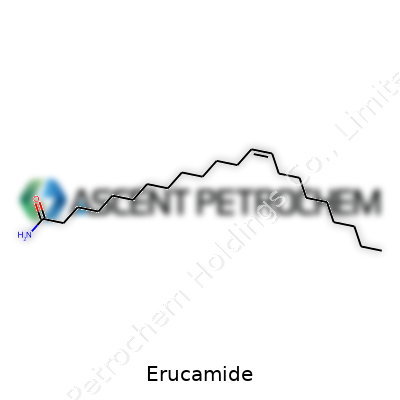
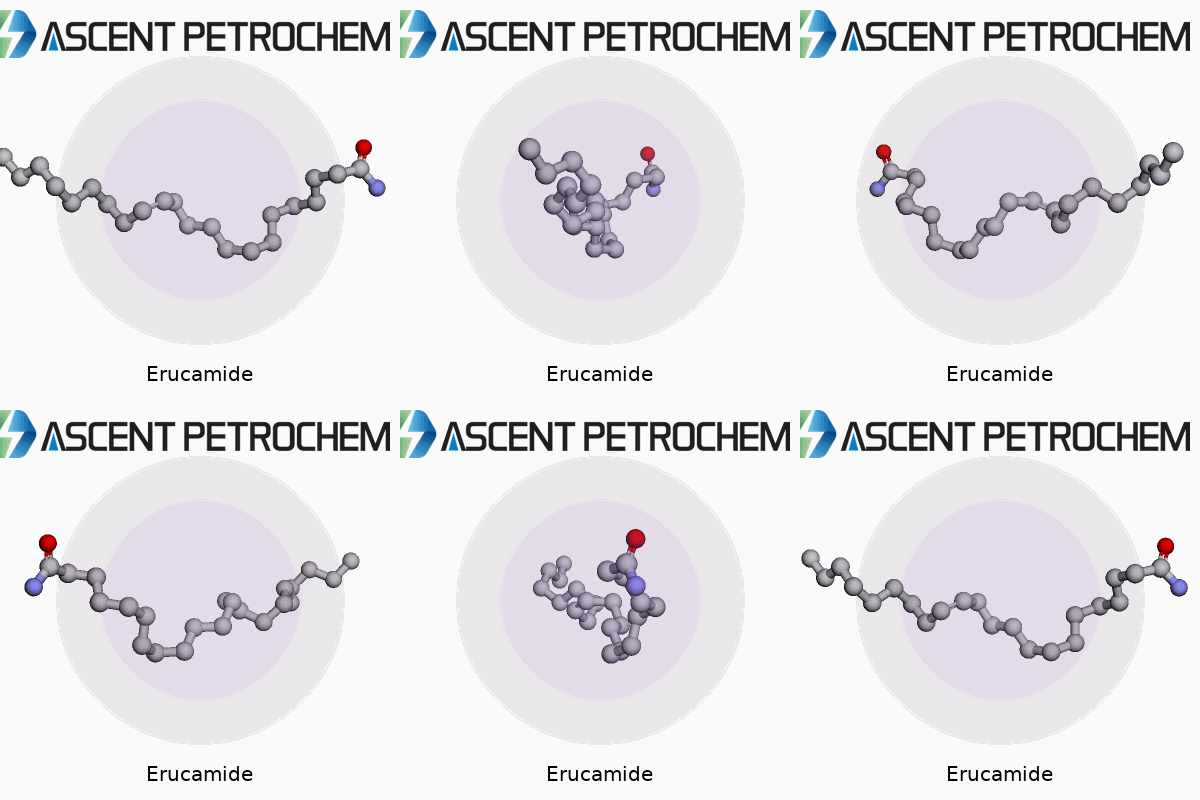
Erucamide sports a long hydrocarbon chain attached to an amide group—chemically, it’s (Z)-docos-13-enamide, with a molecular formula of C22H43NO. As a solid at room temperature with a melting point between 81°C and 84°C, it offers just the right touch of lubricity while remaining stable in most processing environments. Insolubility in water means it doesn’t leach away easily, while its solubility in common organic solvents allows for easy formulation during manufacture. With a density around 0.84 g/cm³ and low vapor pressure, it presents few hazards under normal conditions. This stability means it doesn’t break down or react except under strong acidic or basic conditions, making it a reliable choice for producers aiming for high-throughput extrusion lines.
Suppliers deliver erucamide that meets tight specifications: minimum purity of 98%, specific melting point ranges, and low metal content to avoid contamination in sensitive packaging. Labels list its CAS number (112-84-5), batch number, manufacturing date, and, for European shipments, REACH registration details. Some customers require guarantees that no genetically modified organisms appear in the source material, a nod to the traceability now demanded by food-contact legislation and global brands. Precise technical data sheets, checked by qualified laboratory staff, give the assurance converters need to keep lines moving at speed without running into regulatory snags.
Industrial production builds on the reaction of erucic acid, typically extracted from rapeseed, with ammonia in the presence of a dehydrating agent such as phosphorus pentachloride or thionyl chloride. This process forms erucamide via amidation—a reliable, high-yield synthesis that has withstood the test of time because it scales easily and produces little waste. Facilities often recycle solvents and reagents to cut costs and environmental footprint, while purification gets done through recrystallization. With every passing year, chemical engineers refine yields, aiming for reduced side-products and lower energy requirements as sustainability targets tighten.
Though erucamide holds up well under usual processing, chemical researchers do experiment with modifying its structure. For instance, partial hydrogenation shortens the unsaturated bond, which impacts how it migrates to a polymer surface. Some startups investigate grafting polar groups onto the erucamide backbone to improve dispersion, hoping for anti-static or anti-fogging effects in specialized packaging. In academic labs, the amide group draws interest as a target for more sophisticated functionalization—techniques like acylation, halogenation, or esterification could unlock new applications down the road. Yet in practice, the industry sticks with classic erucamide, counting on its simplicity and well-understood migration during film processing.
In catalogs and technical papers, erucamide wears many hats: erucylamide, (Z)-docos-13-enamide, and even forms like 13-Docosenamide. Some trade names are tied to regional suppliers, but all point to the same underlying molecule. This variety sometimes causes confusion for procurement teams jumping from American to European or Asian sources, where product labeling reflects local norms or regulatory requirements. In most contexts, “erucamide slip agent” sums up its main role—providing that crucial lubricity for polymer films that need to move cleanly, resist sticking, and tolerate winding and unwinding cycles.
Factories handle erucamide without major incident, but operators train for best practices, given pressures from health & safety regulations. The main hazards stem from dust generation, so plants run localized extraction and issue protective equipment to staff filling or emptying hoppers. Packaging must keep out moisture, as wet granules clump and can jam loss-in-weight feeders. Material Safety Data Sheets are produced in line with OSHA and REACH rules, and long-term storage checks make sure degradation or contamination doesn’t creep in. The low acute toxicity and inert character open doors for use in food-contact applications, though food authorities ask for migration data and sometimes molecular weight distribution reports to confirm purity. These requirements are not just box-ticking—bad batches or poor labeling pose a real risk, as seen in recalls and import seizures over the years.
Plastic film extrusion remains the king of erucamide consumption—supermarket bags, shrink wrap, bread bags, and stretch film draw on erucamide to keep surfaces slippery, speed up packing, and keep lines humming. Without it, even brand-new automated packaging machines would face stacks of films fused together, lost minutes, and wasted material. Nonwovens, rubber goods, and adhesives also use erucamide, not only for slip but as a release and anti-caking agent. In the past few years, cable manufacturers and wire producers have picked up erucamide-coated tapes as easy-pull guides during installation. The trend toward lighter, more complex food packaging brings new challenges—films need to release from old-style rollers at higher speeds, and the anti-fog feature helps extend shelf-life for produce and meat in clear wrap. When material prices shoot up or resin shortages bite, additives like erucamide become a lifeline for keeping films thin without sacrificing processability or durability.
Industry and academia both see erucamide as a foundation for new product development. In university labs, research dives into how slip agent migration depends on film morphology and blends of LDPE, LLDPE, and BOPP. Scientists from packaging giants test erucamide in modified-atmosphere films, pairing it with other additives like anti-blocking silica or antioxidants. Some R&D teams want to replace erucamide entirely, spurred by the growth of bio-based polymers and the search for additives with even lower migration rates. Others stick with erucamide but explore new surface modification methods—plasma treatment or layer-by-layer deposition—to optimize slip without excessive blooming. Conferences on food safety and flexible packaging regularly feature debates over the balance between additive migration, surface quality, and contamination risk—showing how far this old workhorse of an additive now finds itself in the thick of high-performance, sustainable packaging innovation.
Toxicologists have put erucamide under the microscope, with most studies pointing to low acute toxicity in mammals and limited bioaccumulation. Chronic exposure models in rats and cell cultures typically show little cause for alarm, and most major regulatory bodies accept its use in limited amounts for food-contact packaging. Migration studies, done at elevated temperatures and various food simulants, keep safety at the center—showing that erucamide, when produced and applied according to standards, stays within safe exposure thresholds. Some gaps linger, especially regarding nanoparticle contamination or impurities from poorly cleaned production lines, so vigilance remains essential. I’ve seen line managers step up quality checks after scare stories surfaced about other slip agents, knowing that consumer trust in safe packaging sits on the back of unglamorous but essential additives like erucamide.
Erucamide stands at a crossroads. Many companies work to cut dependency on petroleum-derived polymers, yet erucamide’s plant origins offer a counterweight to worries about fossil-sourced additives. Bio-based erucamide, if scaled, slots neatly into low-carbon narratives for consumer brands. Researchers chase after less migratory slip agents for multilayer and high-barrier packaging, but cost, regulatory inertia, and erucamide’s proven track record slow the spread of alternatives. Technical tweaks, like blending with other amides or developing modified forms, remain a priority for forward-looking labs that balance legacy recipes with modern environmental targets. As end-user expectations climb and global regulations tighten, erucamide may keep its role—so long as manufacturers invest in cleaner, safer processes, guarantee traceability, and ride the wave of research shaping the new landscape of packaging chemistry.
A lot of folks don’t realize just how often their lives brush up against chemicals like erucamide. This waxy compound changes the game for manufacturers working with plastics. In my years, I’ve found the items we use every day often owe their smooth feel and flexibility to something behind the curtain. Erucamide falls into that category, acting as a slip agent for plastic films. Hold a chip bag, twist a bread wrapper, slide your hand along shrink wrap—you’ve probably enjoyed the work of erucamide without knowing it.
Plastic films stick together unless something steps in to stop it. I remember struggling with cheap plastic bags sticking in humid weather, sweating it out just trying to open one. Erucamide helps break that frustration. Added during the film manufacturing process, it migrates to the surface, forming a tiny lubricating layer. Bags stopped clinging; packaging lines moved faster. Whether it’s food packaging, agricultural films, or medical devices, erucamide keeps materials separate, lightweight, and easy to handle.
The story of erucamide doesn’t end with bags and wraps. It also appears in printing inks and cosmetics. Not everyone realizes that lipstick glides on smoother because of chemicals like this. Rubber manufacturers add erucamide so rubber doesn’t stick to molds or roll up on itself. I remember walking factories where piles of stacked sheets slid apart with hardly any effort, all thanks to this slippery ingredient.
With so many products passing through our hands every day, even one improvement in feel and performance gets noticed. If plastic films don’t open easily, customers get frustrated. Slow machinery racks up costs. Failures in performance can make a company look sloppy in the eyes of the market. In countries with high humidity, poor slip in packaging can ruin entire shipments. I’ve seen small improvements in slip not only smooth production but even cut energy use, since less force means less heated machinery. That’s real cost saving and efficiency—and less waste.
The more we depend on any chemical, the more questions come up. Some worry about migration into foods, especially when packaging touches high-fat products. Research points out erucamide stays stable and non-reactive in most uses, but consumer safety can’t run on assumptions. Good manufacturing leaves no gaps: regular testing, strong documentation, and oversight matter. Regulators in places like the EU and U.S. FDA keep erucamide on their radar, watching for new findings. Anyone working with this compound—whether a big company or a small shop—must follow best practices and keep an eye on emerging studies.
One lesson from years on the shop floor and the lab bench: no solution lasts forever. Markets shift, rules tighten. Some companies look toward alternatives made from plants or recycled sources, both to reassure consumers and reduce their own risk. Keeping honest about what goes into our packaging, how it affects health, and how we handle waste will mean smoother, safer products in the long run.
Erucamide acts as a slip agent in plastic films. Manufacturers rely on it to keep packaging materials from sticking to each other. That means smoother runs on production lines and fewer headaches for anyone packaging things like snacks, cheese, or fresh produce. Back in my college chemistry days, I never thought such a tiny chemical tweak would change an entire industry. Yet this simple additive shows up everywhere, from chip bags to bread wrappers.
Folks who spend their days thinking about what goes into food packaging worry about migration — those are the chemicals moving from packaging into the food itself. I’ve seen plenty of research that says even small changes in packaging impact what winds up in our meals. The idea of something invisible leaching into my kid’s sandwich never sits well, even though I work in manufacturing.
Authorities like the European Food Safety Authority and US FDA set strict rules about how much of anything — including erucamide — can get into food. Studies show erucamide, in the amounts typically used, doesn’t pose a health risk based on what data we’ve got. The problem is, science keeps moving. Some research points to bioaccumulation and subtle health effects at higher exposure levels. That kind of uncertainty makes honest folks nervous, and, in practice, trust in the process matters a lot when public health is the issue.
European and American regulators both set migration limits for erucamide, often capping it at a few milligrams per kilogram of food. Speaking to food safety experts over the years, I learned that mandatory migration tests replicate all sorts of conditions — temperature swings, different types of food, and long storage times. Producers do their best to meet those standards, but sometimes, mistakes slip through, especially when global supply chains get complicated.
One worry I’ve heard raised by lab folks: not every country polices chemical additives strictly. Shipments cross borders, and not everyone holds themselves to the same standards. Serious gaps can appear, particularly in budget or counterfeit packaging supplies. Staying informed means asking questions about where your packaging comes from and working with suppliers that document exactly what’s in their materials.
Consumers keep pushing for safer and simpler packaging. That pressure already moved the market on things like BPA. Newer plant-based slip agents are gaining traction because they offer similar performance without the baggage of migration concerns. Compostable and bio-based films aren’t widespread yet, but I’ve seen some mid-size brands switching voluntarily.
I’ve sat in on enough safety audits to know testing and traceability go a lot further than just slapping a “food safe” label on something. Sharing full supply-chain documentation — and keeping up with evolving research — helps keep everyone honest. For buyers, asking for test results and certifications should become second nature.
No food packaging system works in isolation. Design choices ripple outward: touch one part, and the impact often surfaces somewhere else. Growing up, my family shopped at local markets and ate fresh. Today’s realities — convenience, transport, shelf life — mean we rely on packaging more than ever. Staying safe comes down to informed choices, transparency, and the willingness to look for better solutions, even in small steps.
Erucamide often lands on the workbench of plastic fabricators and textile makers for a simple reason: its unmistakable slipperiness. A fatty acid amide with a long, unsaturated chain, erucamide grabs the spotlight for its ability to transform the way surfaces behave. Seeking to create bags that open easily or films that don’t weld together in a roll, manufacturers turn again and again to this compound. Its impact comes straight from the science of structure.
Pull erucamide out of a container and it usually presents as a white, powdery solid or, in some cases, waxy flakes. The material has a faint odor, something reminiscent of vegetable oil, which makes sense considering its roots in natural erucic acid from rapeseed oil. Run it between your fingers, and you’ll notice the slip. This feeling is exactly what factories want when they add it into plastics and coatings. The molecular backbone, a twenty-two-carbon chain finished with an amide group, delivers the right balance of softness and structure.
Erucamide doesn’t melt at room temperature. Instead, it holds its solid form up to between about 80°C and 86°C (176°F to 187°F). Past that, it melts into a clear, oily liquid. This melting range fits well with plastics processing, where temperatures climb but not so high that they’d scorch the additive. Factories count on consistent performance through repeated heating and cooling cycles, which means erucamide can go through extruders and mixers without any issues.
This compound isn’t eager to blend with water. Try dissolving it in a glass of water, and all you get is a floating, unmixed layer. Solvents like ethanol, ether, or hot organic oils, on the other hand, handle it well. That’s what opens doors to coatings, inks, and films—a wide range of uses where erucamide can be distributed evenly across surfaces. This property lets it rise to the film’s surface during processing, where it spreads out and acts as a lubricant, separating layers and letting materials slide over one another with very little resistance.
Erucamide keeps its performance in storage. You won’t see it rapidly break down or lose effectiveness as long as it stays in a sealed package away from direct sunlight. High temperatures don’t trouble it until you approach its melting point. That reliability matters for warehouses and manufacturing lines. Nobody wants to open a drum of raw material just to find it’s turned lumpy or lost its edge. In practice, most users report shelf lives of several years without degradation.
People have leaned on erucamide for more than its chemistry—it’s about trust in real-world results. Polyethylene and polypropylene films come apart easily because of a thin film of this compound, not because someone decided to reinvent the process every week. When regulators and researchers tracked its migration through food packaging, they found levels that met safety standards. Factories get products that do their job, and users enjoy bags that open without swearing or fuss. That kind of physical reliability gets noticed, year after year.
Every time you pick up a plastic bag at the grocery store or snap a lid onto a container, there’s a good chance erucamide or oleamide helped make things smoother. Both of these additives can be found in a long list of plastic and rubber products because they give them that slip and anti-block quality manufacturers and users need. Most people never spend time wondering why some bags peel apart easily while others stick together in a frustrating way.
Even though erucamide and oleamide both belong to the family of fatty acid amides, their properties don’t play out the same way. Erucamide is made from erucic acid, a fatty acid with a long, 22-carbon chain and one double bond. Oleamide is derived from oleic acid, which has only an 18-carbon chain with one double bond. That chain length might sound like a tiny chemical detail, but it ends up making a big difference in the real world.
With a longer tail, erucamide spreads out on film surfaces and helps keep sheets of plastic from fusing together under pressure or heat. This feature turns out to be especially handy in packaging and film for food, where sticking and tearing get in the way of fast production or quality presentation. Oleamide also acts as a slip agent, but its slightly shorter structure lets it migrate—or move through—the polymer matrix a bit faster. This speed works well when speedy effect is needed, but it doesn’t stay put as long during storage or use. Erucamide tends to stick around, so it’s favored in situations where lasting slip matters.
Talking about plastics and food contact, safety takes the front seat. Regulatory bodies like the US Food and Drug Administration (FDA) and the European Food Safety Authority (EFSA) keep close tabs on which additives can touch food. Both erucamide and oleamide go through reviews before approval, but there’s a bit of caution around erucamide’s erucic acid source. Too much erucic acid has been linked to heart and liver issues in large doses, so producers monitor levels carefully, mostly in items like infant formula containers and certain food wraps.
There’s also a question of performance over time. If you’ve pulled out a plastic bag that has sat in storage for months and noticed it feels different than when it was fresh, it could trace back to how erucamide or oleamide has migrated through the layers or on the surface. Oleamide might disappear faster, cutting down slipperiness in storage, while erucamide stays put, keeping things consistent.
Both erucamide and oleamide come from natural fats, often from plant oils like canola or rapeseed. This might sound renewable, but farming and extracting these inputs can raise questions about land use and sustainability. Supply chain disruptions or price swings for raw materials can ripple down to manufacturers and consumers.
Some researchers are digging into alternatives—bio-based or synthetic slip agents that could step into the same roles. Other teams take a hard look at making films and packaging that need fewer additives to work well. As sustainability grows in importance, the pressure builds for slip agents to deliver long-lasting performance and reliable safety, all without loading up our supply chains with new problems.
In the end, picking between erucamide and oleamide depends less on chemistry and more on what the final product needs—how long it will be stored, how it will be used, and what kinds of regulations touch it. Understanding what sets them apart matters for anyone who cares how plastics perform and what touches their everyday life.
Erucamide plays a practical role in the plastics industry. It delivers slip properties that help films release more easily during processing, keeps packaging from sticking together, and improves the feel of everything from bread bags to stretch wrap. No fancy jargon — without it, many plastic products don’t work as smoothly or last as long in use. People in the business world know that speed and consistency matter, especially in high-speed packaging lines.
Manufacturers often add erucamide at concentrations between 0.05% and 0.3% by weight of the polymer. The sweet spot for most film products lands at about 0.1% to 0.15%. That range isn’t picked out of thin air — too little leaves bags stubbornly sticky, too much leads to oily residue, smearing or other processing headaches. I’ve seen machine operators get squeezed schedule-wise because of overdosing, needing to stop lines to clean rollers and adjust temperatures. Choosing the right amount prevents these slowdowns.
The European Food Safety Authority (EFSA) set an upper limit of 2 mg/dm² for erucamide migration into food. Global safety standards usually echo this benchmark, since overexposure can impact health, especially when plastic touches food products. Reports from the U.S. Food and Drug Administration show that sticking around 0.1% keeps things well within safety limits for consumer packaging. Every large producer runs migration tests to confirm that what leaks out stays well below these thresholds.
No one likes to waste money. The minimum needed to achieve a good slip effect should guide every choice. Polyethylene and polypropylene require a different approach: polyethylenes tend to need less because of their natural slickness, while polypropylene, which is stiffer, sometimes requires higher concentrations. Film thickness also plays a role. Thin films often need a bit more so the additive can reach the surface quickly enough, especially in fast-moving production environments.
External factors shape dosage, too. Hot, humid climates draw out slip additives at a different rate compared to cool, dry warehouses. As a former plastics engineer, I remember weeks when summer humidity in the Midwest cut the effective slip life of bags by half, forcing us to tweak dosages batch by batch. Transparent films for food need closer attention than dark or printed wraps, since migration shows up faster and could threaten product safety certifications.
Choosing the correct level always comes back to performance testing and checking for customer complaints. Good suppliers run pilot trials on their actual equipment, then retest if they switch suppliers or raw material lots. Resin quality, processing temperature, and even colorant choice affect how erucamide spreads through the material. The certification team signs off only after confirming every batch hits both sliding performance and food safety targets.
A smart solution: treat each new project as a blank slate. Lab screening, not just a book value, should drive decision making. Some days, being just a little below target is better than risking too much — you save money, extend machine uptime, and steer clear of regulatory hiccups. No two runs are quite the same, but evidence and vigilance keep both engineers and customers in the clear.