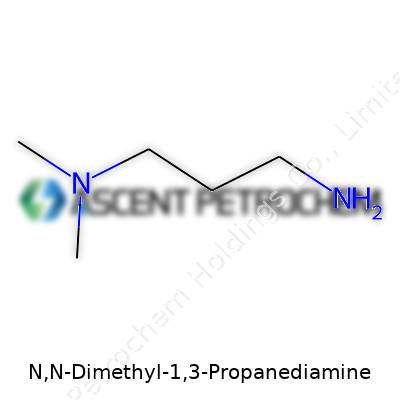
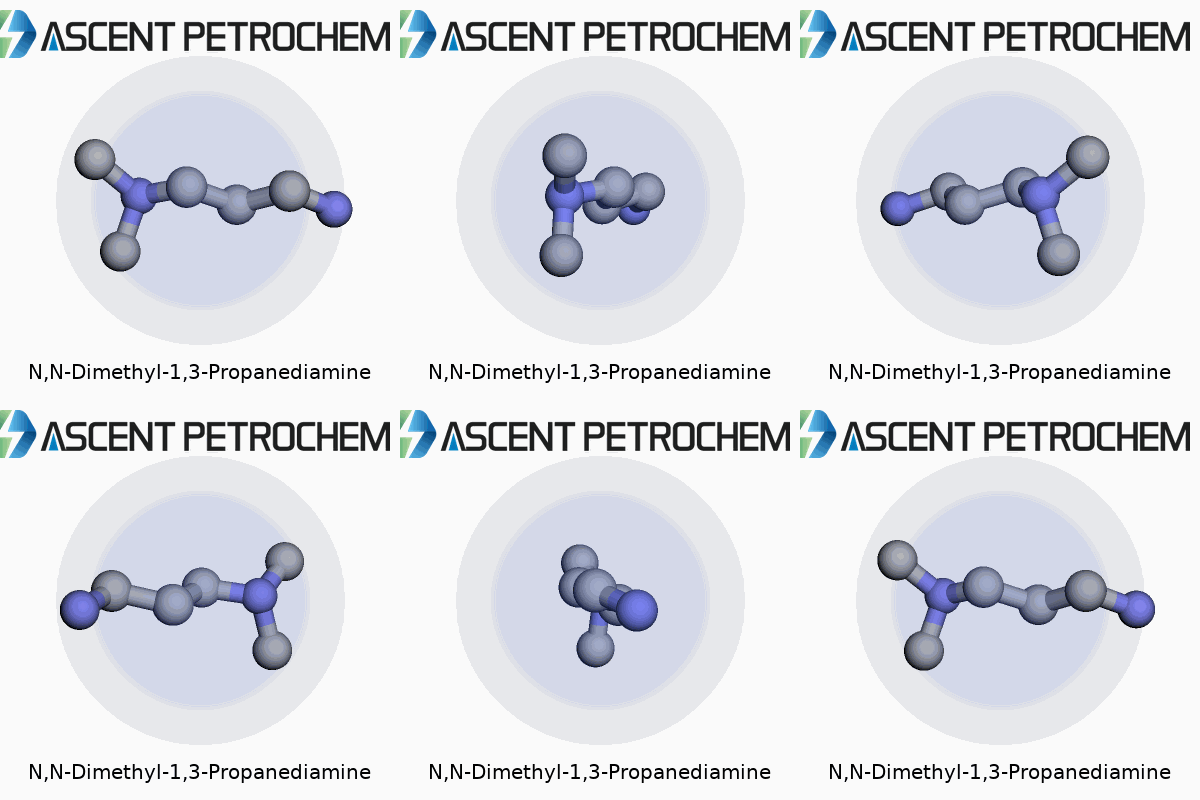
Chemists began exploring the fields of multi-functional amines in the twentieth century, and N,N-Dimethyl-1,3-propanediamine grew out of that search for versatile building blocks. Early manufacturing of polyamines came from demands in polymer production and surfactant science. At first, industrial synthesis shared space with pharmaceutical discovery, since both fields sought flexible nitrogenous compounds. Over the decades, engineers improved processes, shifted raw materials from coal tar to more refined petrochemical feedstocks, and chased reliable output, high purity, and cost controls. Producers in North America, Europe, and eastern Asia shaped its commercial path, following growth patterns in coatings, water treatment, and resin modification.
N,N-Dimethyl-1,3-propanediamine stands out as a colorless-to-pale yellow liquid, carrying a strong, ammonia-like odor. Companies sell it as a base chemical. Its formula, C5H14N2, allows for a little flexibility in storage and handling, though it remains strongly alkaline and reactive. I've taken part in batch storage checks and noticed how sensitive this diamine can be to humidity, which makes proper sealing necessary to prevent degraded product. Bulk containers bear clear hazard labeling. In production, firms care about consistent viscosity, free amine content, and amine value, since these factors play into downstream effectiveness.
The compound boils around 138–140°C at atmospheric pressure. Solubility in water runs high, making it easy to incorporate into various liquid formulations. Molecular weight clocks in at just over 102 g/mol. In laboratory tests, it mixes well with alcohols, ethers, and chloroform. Because it's a diamine, it reacts quickly with acids, isocyanates, and carbonyl groups. Flammability becomes a concern above flash points of 38°C. Strong, amine-based odor escapes if containers vent, calling for good local ventilation. Viscosity remains low, and density hovers right under 0.83 g/cm3.
Buyers expect specifications matching industrial needs: purity above 99%, moisture well below 0.2%, and minimal trace impurities. Manufacturers print UN number 2734 on drums, with GHS pictograms for flammable and corrosive materials. The SDS outlines physical hazards, such as causes severe burns, and highlights incompatibility with acids and oxidizing agents. Container valves need pressure-relief systems, since temperature swings can prompt expansion or off-gassing. Barcoding and batch lot labels make traceability possible for product recalls or quality audits.
Industrial synthesis relies on methylation of 1,3-propanediamine, often using formaldehyde and hydrogen sources as methyl donors. Continuous reactors produce cleaner output versus batch methods, since side-reactions fall off with tighter control of heat, reagent ratios, and residence times. Nickel-based catalysts support the methyl addition, and distillation helps recover the target product from byproducts and unreacted amines. In smaller research-scale work, one sees more variation in catalysts and feedstocks, but commercial supply focuses on reproducibility and cost. The advent of dedicated reactors brought down per-liter prices in the last decades, making the compound accessible to mid-scale manufacturers.
N,N-Dimethyl-1,3-propanediamine acts as a nucleophile and base in organic synthesis. It reacts briskly with epoxides to form polyamines used in curing epoxy resins. Addition with acid chlorides yields amides, tailored for specialty chemicals. As a ligand, it binds transition metals in catalyst research. In my own lab time, I've mixed it as a co-monomer in polyamide and polyurea experiments, observing how chain flexibility and hydrophilicity shift depending on reaction ratios. Selective quaternization generates surface-active agents, opening paths for detergents and biocides.
In the marketplace, N,N-Dimethyl-1,3-propanediamine bears several names: DMAPA, 1,3-bis(dimethylamino)propane, or DMAPDA. Sellers might market specialized blends for resin, textile, or water-treatment sectors, but the core chemical remains identical. Product codes and CAS number 109-55-7 simplify regulatory compliance and inventory tracking. I've reviewed shipment manifests listing these synonyms interchangeably, and staff training always reinforces the importance of matching safety information to the right synonym or branded product.
Use of N,N-Dimethyl-1,3-propanediamine demands strong workforce safety protocols. Dermal and eye exposure can lead to burns. Inhaled vapors cause respiratory tract irritation. Studies show that chronic exposure triggers sensitization. Companies enforce nitrile gloves, polycarbonate goggles, and local exhaust ventilation. In storage, fire-resistant rooms and secondary containment handle leaks or spills. Regular training keeps teams on top of emergency procedures, and facilities test alarms and spill kits twice yearly. Environmental rules require spill reporting and careful management to prevent groundwater contamination. Disposal goes through licensed incinerators, since water treatment plants cannot break down the diamine’s core structure efficiently.
This chemical finds its way into epoxy curing agents, personal care surfactants, textile softeners, and water-treatment polymers. Epoxy formulators use it to enhance flexibility without destroying chemical strength. In cosmetics, quaternized forms act as anti-static agents for hair products. Textile finishers see value in its softening and emulsifying properties. Municipal and industrial water treatment plants use derivatives to adjust charge balance for sludge dewatering and contaminant removal. Diagnostic reagent firms tap it as a spacing agent in specialty syntheses. In my experience, research-grade samples go into sensor development, where primary and secondary amines open bonding sites for analyte detection.
Researchers look for greener methylation routes and improved catalysts to limit waste and energy consumption. Bio-based alternatives aim to reduce reliance on petrochemical feedstocks, but cost remains a barrier. Ongoing work investigates applications in smart coatings, gene delivery systems, and drug conjugates. As the push for circular chemistry grows, teams experiment with capturing and recycling spent materials, closing the loop on industrial waste. Collaborative projects between academia and industry share findings on product stability, shelf-life, and compatibility with next-generation resins and fibers. Patent filings show a steady stream of new derivatives, indicating innovation remains robust.
Toxicological profiles reveal N,N-Dimethyl-1,3-propanediamine as moderately hazardous. Acute oral and inhalation toxicity sits in the middle range for common amines. Repeated skin contact damages tissue. Eyes take severe injury even at low exposures. Environmental assessments rate it as harmful to aquatic organisms, especially in concentrated spills. Animal-data benchmarks inform workplace exposure limits, typically set at low ppm in air. Data from regulatory agencies underscore the need for closed systems and careful monitoring during large-scale handling. Several research groups test less-irritating alternatives, but nothing matches the reaction speed or cost performance so far.
Looking ahead, demand grows in specialty chemicals as well as next-generation polymers with environmental certifications. Regulatory pressure tightens around discharge limits and occupational hazards, spurring capital projects for safer storage and dosing. Research into new curing agents for green construction and advanced composites creates more niche markets. I see potential in biotechnology, where functionalized diamines offer promising tools for surface modification and delivery systems. Improvements in catalyst design and process intensification could cut waste and boost efficiency, aligning with sustainability targets. As the world pivots to safer, cleaner chemistry, N,N-Dimethyl-1,3-propanediamine stands as both a challenge and an opportunity for the next wave of innovation.
Epoxy resins build the bones of coatings, adhesives, and sealants found in cars, electronics, and bathroom tiles. N,N-Dimethyl-1,3-propanediamine (DMPDA) does a key job as a curing agent by speeding up the chemical reaction that hardens these resins. Over years working with home improvement suppliers, I've noticed that buyers care about things that last and stay resilient under weather and stress. This type of amine brings that toughness. It cuts curing time for workers and helps coating makers create scratch-resistant finishes, which matters to anyone who’s tried cleaning paint smears off a garage floor.
Clean water supplies shouldn’t be out of reach. DMPDA steps up as a raw material to create polyamines—compounds that trap and clump tiny unwanted particles in municipal water plants. My time spent consulting for rural water authorities taught me these clumps help pull grime and metals from water, making it safer from source to tap. Although full oversight from agencies like the EPA keeps chemistry use in check, DMPDA’s role remains a behind-the-scenes win for safe drinking water.
Countless office chairs, gym mats, and beds contain polyurethane foam. Foam producers rely on DMPDA to adjust how these cushions spring back after use. Its chemical backbone lets manufacturers fine-tune both softness and resilience. In textile factories, DMPDA helps create agents that boost dyes, so colors stay sharper for longer. Every time I see bold uniforms or bright towels in hotels, I remember conversations with dye houses grateful for additives stopping colors from fading after a few months.
Household cleaners and shampoos work because they blend water-loving and oil-loving ingredients. DMPDA helps in the production of surfactants—the front-line workers that cut through grease. By breaking up stubborn grime and helping water rinse it away, cleaners become much more effective on kitchen counters and laundry stains. The chemistry sounds complicated on paper but stands out most when it just gets the job done for families on a budget.
Plenty of chemical tools do valuable work, but responsibility sits on us to use them wisely. DMPDA brings performance, yet it needs careful handling during production because of its corrosive nature and potential health impact. Seeing stricter controls show up from OSHA and REACH in Europe matches what I’ve heard during safety audits: training and proper storage matter. The push towards greener alternatives often starts with companies looking for ways to recycle or cut emissions during the production of chemicals like DMPDA. Innovators in specialty chemicals talk about closing the loop on waste and swapping in sustainable feedstocks, and those efforts need support from buyers, regulators, and the people using the end products.
N,N-Dimethyl-1,3-propanediamine shows up in chemical texts as C5H14N2. This small molecule has two amine groups on either end, with a carbon chain bridging them and a couple of methyl groups hanging off the nitrogen. On the scale, it weighs in at about 102.18 g/mol. These details matter because even a tiny shift in structure or mass can change the way a molecule acts, which speaks to why understanding chemistry often feels like learning a new language.
I remember digging through an old college organic chemistry book, realizing just how much power a simple pair of methyl groups bring to a molecule. Add them, and suddenly that molecule might slide through reactions that would block its unmethylated cousin. For N,N-Dimethyl-1,3-propanediamine, the combination means it reacts differently from plain old propanediamine. Factories prefer these small tweaks. The chemical’s amine groups make it good for binding with acids or forming longer chains, acting as a bridge in more complex synthesis. This isn’t just academic — big manufacturers rely on details like this to make high-performance coatings, improve dye uptake, or develop new polymers used in automotive parts or medical supplies.
The cheerful chemical structure hides the reality: many simple amines can irritate skin, eyes, and lungs. OSHA places sharp controls around exposure. When I worked in a lab, routine meant gloves and eye protection — even with something that seemed harmless on paper. Safety data shows this compound can cause harm if mishandled. People working around it need up-to-date information, training, and equipment. Ignoring the risks usually lands someone in trouble, fast. Companies that don’t follow clear safety protocols risk more than fines; they endanger their entire workforce, and reputations don’t heal quickly.
Modern chemical manufacturing faces heavy scrutiny over spills, emissions, and waste. N,N-Dimethyl-1,3-propanediamine, like other amines, tends to break down in the environment, but not fast enough for comfort. Unchecked releases pile up in water systems, straining treatment plants and threatening wildlife. The EPA recommends best practices that focus on capture, recycling, and safe disposal.
After seeing a local river recover from past chemical runoff, I believe strong oversight and investment in waste handling work. Partnerships between industry and local governments help track and lower emissions. Risk remains when budget cuts eat into monitoring efforts, so strong policies need teeth and regular review.
Many people outside research might not know this compound by name, but products made with its help sit on store shelves everywhere. Employees, communities, and customers deserve clear information about what’s in the supply chain. Industry groups have started providing more transparent reporting, which boosts trust. In my experience, the best solutions come out of open dialogue between researchers, manufacturers, and those living near production sites.
By staying curious and demanding high standards from everyone involved, we can make sure chemicals like N,N-Dimethyl-1,3-propanediamine support progress without causing harm.
Every product has a story before it gets into our hands. Sometimes, that story gets overlooked. Manufacturers pour money and knowledge into making safer, better goods. But once these items leave the factory, their safety and quality sit squarely on storage and handling. I remember walking into a local pharmacy years ago, scoping out a shelf full of cough syrup. It struck me that some bottles felt warm, even though the label shouted, “Store below 25°C.” This tiny miss can turn a medicine useless or, worse, cause harm. Products always respond to their environment—heat, light, moisture—all of it changes what happens inside a bottle or bag. Mishandling can cost lives, jobs, or businesses.
Storing things next to a window, letting sunlight beat down, or stacking cartons too close to heating vents—these choices can destroy value fast. Food spoils, lotions separate, chemical products clump or degrade, and just about any pharmaceutical can lose potency in heat or humidity. The results? A hit to health, credibility, and the bottom line. I’ve seen small shops ignoring basics because space was tight, or workers skipped reading the label. No surprise; if training is not consistent, mistakes happen. A recent World Health Organization report found up to 10% global losses in some medicines just from poor storage. That percentage stands out because it means waste, higher prices, and people missing out on what they need.
Common sense guides a lot, but good storage should follow trusted, expert advice. For most pharmaceuticals and perishable goods, the recommendation lands between 15-25°C, away from sunlight, moisture, and fumes. Dry products stay best in airtight containers. Anything sensitive—like insulin, certain vaccines—belongs in a fridge around 2-8°C. Taking time to ensure shelves and storage rooms have thermometers and humidity monitors makes a bigger difference than most expect. In my experience, cheap fixes like tinted window film and sealed containers stretch a product’s life and save on repeated orders. Don’t stack items too high, since crushing damages packaging and crowds out air flow, and always clean spills to keep bacteria at bay.
Labels don’t only matter for customer instructions, but for anyone handling the goods. If the box says “Keep dry,” take it seriously. Workers need clear direction on where and how items should be kept, and training helps spot trouble early. The best operators run regular checks, ask questions, and treat every package as something they would use at home. Digital tracking now makes this easier than ever; monitoring temperature and location gets real-time, automatic alerts sent to phones. Regulatory agencies like the US FDA enforce strict storage laws on certain products, which often means fines or worse for businesses that cut corners. Taking storage seriously protects consumer health, safeguards reputations, and drives long-term trust.
Storing and handling aren’t glamorous jobs, but they keep everything running smoothly. Staff who tackle small chores—rotating stock, double-checking storeroom temperatures, logging shipments—build a foundation for safety. All the right systems in the world won’t matter if the basics get skipped in practice. I’ve seen the difference firsthand: clear rules, practical training, and affordable tools give everyone in the chain a part to play. The end goal stays the same: reliable, safe, and high-quality products every time.
Working around chemicals means paying attention. N,N-Dimethyl-1,3-propanediamine isn’t a chemical to brush off. In my experience with industrial settings, just reading a preparation’s label isn’t enough—you have to think about everything from skin contact to vapors. Studies and safety data make it clear: this substance can irritate the eyes, lungs, and skin. Even a slight exposure can cause chemical burns or respiratory distress. If you’ve ever worked in a lab where someone splashed a small bit of amine compound, you might have seen firsthand how quickly problems show up—red skin, watery eyes, even someone coughing uncontrollably.
N,N-Dimethyl-1,3-propanediamine isn’t just unpleasant. It’s corrosive and strongly basic, so it breaks down organic matter—including the tissues that make up your skin and membranes. A publication from the National Institute for Occupational Safety and Health (NIOSH) lists amines as possible sensitizers. Symptoms build up over time, and repeated exposure creates bigger health risks. Long-term studies have shown chronic exposure increases asthma-like symptoms and could lead to permanent respiratory issues.
It’s not enough to say “just be careful.” Any mistake could cause injuries, so it makes sense to treat this chemical with the seriousness it deserves. It’s on the radar of several regulatory agencies, and companies can’t skip out on compliance. The Environmental Protection Agency points to amines for aquatic toxicity, too, so spills or improper disposal lead to environmental trouble, not just personal harm.
Safety procedures need to be practical and actually make a difference. The gold standard starts with personal protective equipment—nitrile or neoprene gloves, full-face shields, chemical splash goggles, and lab coats. Cotton blends don’t stop a spill, so chemical-resistant aprons or full suits are better. Relying on simple dust masks or going bare-handed is asking for trouble.
Good ventilation—local exhaust or at least fume hoods—should run every time. Relying on open windows or fans falls short, especially for airborne fumes. If you’re storing it, keep it away from acids and oxidizers. In my work, I’ve seen old containers create gases after sitting too close to incompatible substances. Always use containers clearly labeled and sealed tightly.
Don’t let habits get lazy. Wash hands and change clothes after work to avoid indirect exposure, especially before eating. I’ve known several colleagues who started with rashes that turned worse because they forgot this step. Emergency showers and eye wash stations near work areas save time during spills, and anyone working unsupervised needs real training, not just a handout on Day One.
Safer handling happens through culture as much as controls. Companies investing in training, scheduled drills, and quick response systems see fewer accidents. Sharing near-miss stories makes lessons stick better than rules on a poster ever will.
If jobs can shift to less hazardous substances, smart companies do it. Even if that means greater expense or time upfront, no injury or environmental penalty comes cheap—or forgettable.
Every workplace culture that values open reporting on spills or exposures stays safer. Reporting isn’t tattling; it’s how people stay healthy and learn as a team. For me, those conversations have shaped more improvement in safety than any regulation on the books.
Buying chemicals like N,N-Dimethyl-1,3-Propanediamine isn’t the same as picking up aspirin at the pharmacy. Anyone who’s had a hand in procurement for a lab or manufacturer knows the juggling act involved—cost, compliance, efficiency, and safety. N,N-Dimethyl-1,3-Propanediamine usually comes in a few main sizes. You see small bottles, sometimes in the 500-gram or one-liter range, aimed at research or quality control rooms. Bigger operations, like those in industry, go for drums (200 liters is common) or even giant intermediate bulk containers (IBCs) that may hold over a thousand liters. Some producers offer custom fills, so it’s not always a “take it or leave it” deal.
Choosing a container size isn’t about ticking a box. In bigger batch production, using IBCs cuts down on time lost to swapping containers. At my last job, working with hardeners for epoxy resins, handling in 200-liter drums was standard. Anything smaller would have slowed us down and increased the risk of spills or wasted product. On the research side, a small bottle reduces exposure and keeps budgets in check. No one wants to pay disposal fees for a half-empty drum just because it went off before you could use it all. Universities or R&D folks know this pain all too well.
Chemical packaging isn’t only about efficiency—it also means thinking about storage and safety. Storing big drums takes up space and ramps up risk. I remember a former workplace switching from 200-liter drums to 20-liter kegs after a minor leak. Smaller packaging helped limit the chance of spills turning into a headache for everyone involved. Regulatory rules, like those from OSHA or the EPA, shape what sizes a company stores on site too. Too much hazardous material on hand can push a business into a tougher regulatory bracket, which means more inspections and paperwork.
There’s a balancing act between volume discounts and cash flow. Going with larger containers lowers the price per kilo, but not every business can tie up capital in big orders or handle surpluses. Smaller companies often get pushed into buying less-attractive sizes, like 20-liter pails, because cash and space are both limited. Distributors try to manage risk by carrying the most popular sizes, which are usually the ones that work for the biggest customer base. If you have niche needs, prepare to wait longer—or pay more.
Disposing of chemical packaging adds an environmental layer. Large containers lead to less plastic and steel waste per unit of chemical, but if leftovers go unused, it’s a net loss. Some suppliers now run drum-return or reconditioning programs, helping shrink a company’s environmental footprint. In a few projects, I’ve seen teams plan their procurement around shared chemical stocks, making sure everything gets used up before expiry.
Talking to suppliers about flexibility pays off. Reliable partners may offer just the sizes you need or help bundle shipments. Asking about extra handling, safety instructions, and whether containers meet local or international shipping rules makes life easier down the road. Research and manufacturing don’t always overlap on packaging needs, so it’s smart to review processes often and make a habit of rechecking demand before buying in bulk. In my experience, the best operations cut waste and costs by keeping the conversation open between purchasing, safety, and the floor staff using the product.