
Oleyl imidazoline came onto the industrial scene in the mid-20th century, right as the oil and gas industries searched for robust anti-corrosion agents and surfactants. Researchers noticed that traditional amines handled corrosion, but not very gently, prompting a look toward molecules offering both power and finesse. By combining an unsaturated fatty acid—oleic acid—with ethylenediamine, chemists struck on a blend that supported the push toward longer equipment lifespans and more efficient blends in detergents, lubricants, and protective coatings. As the range of applications expanded, so did the global commitment to synthetic additives that met both technological and environmental expectations.
Chemists describe oleyl imidazoline as part of the imidazoline family, presenting as a viscous, amber liquid. Most everyday users probably know it from industrial products targeted at reducing metal deterioration or skin irritation. In oilfields, it's standard practice to find this compound packed inside corrosion inhibitors and demulsifier formulations. Several detergent and cosmetic lines rely on it as a conditioning or softening agent. Its popularity rests on surfactant properties, paving the way for better blending and improved surface activity.
Oleyl imidazoline displays oil solubility, handling high salinity and wide temperature swings, typical in harsh industrial settings. Its molecular skeleton roots in a long alkyl chain, lending hydrophobicity, while the imidazoline ring brings in the polar edge that locks onto reactive surfaces. At room temperature, it sticks around as a yellow-brown liquid, smelling faintly amine-like, due to its nitrogen content. Density clocks in around 0.89 g/cm³, and boiling points hit well above 200°C. With such stability, operators can ship and store large drums without sweating over unwanted reactions.
A quality spec sheet for oleyl imidazoline covers amine value, total amine content, active ingredient percentage, and sometimes, color and odor grade. The product usually registers an active concentration somewhere in the 90–95% range, with labeling that meets GHS criteria—think clear hazard pictograms, storage precautions, and safety protocols. Manufacturers and suppliers stamp containers with dates, batch numbers, and CAS information for compliance. Sourcing remains tightly regulated under both local and international chemical transport laws, demanding transparent communication from producer to end user every step along the logistics chain.
Preparing oleyl imidazoline in a lab or industrial setting requires heating oleic acid with excess ethylenediamine, often under nitrogen, to avoid unwanted reactions with the air. The reaction typically takes place between 180–220°C, with water removal needed to push the process forward. Upon completion, purification steps get rid of excess diamine and byproducts. Experienced operators pay close attention here, since incomplete conversion drags down product performance. Scaling up from bench scale demands careful temperature and pH monitoring to make sure the transition from pilot plant to full production doesn't sacrifice efficiency.
The chemistry of oleyl imidazoline allows further modification. Quaternization, for example, gives rise to new surfactant families by introducing quaternary ammonium groups, making the molecule more water-friendly. Some applications need ethoxylated or propoxylated derivatives, where the base imidazoline backbone undergoes addition reactions with ethylene oxide or propylene oxide, improving solubility or adjusting charge profiles. Reacting with acids like hydrochloric or sulfuric provides the salt forms, which find their way into water-based solutions. This adaptability explains why so many formulators keep it on their shortlist for tricky emulsions, dispersions, or anti-static blends.
Oleyl imidazoline answers to several labels across markets and languages. In catalogs, it pops up as 1-[2-(8-heptadecenyl)-4,5-dihydroimidazol-1-yl]ethanamine, or shortened to N-oleyl-1,3-diaminopropane imidazoline. Specialty chemical houses sell it under trade names like Amine OI, Oleamide Imidazoline, or Imidazoline C18:1. The surfactant world sometimes groups it among condensate imidazolines. Variability in sources, degree of purity, or optional additives means buyers check not just the name, but also the certificate of analysis to sidestep compatibility or regulatory hiccups.
Every worker dealing with oleyl imidazoline needs to treat it with care. Direct skin or eye contact can cause irritation, and inhalation of vapor, although unlikely in open spaces, prompts safety managers to call for good ventilation. Standard PPE includes gloves, goggles, and lab coats. Storage calls for sealed drums away from oxidizing agents and heat. Spills need containment with absorbent materials and prompt disposal as industrial waste. Safety data sheets warn of possible environmental hazards, so effluent management and local water checks keep the chemical from slipping into streams or groundwater.
Ask any engineer in pipeline corrosion what they use to keep assets alive, and oleyl imidazoline comes to mind fast. Its long hydrocarbon tail lets it adsorb right onto metal, forming invisible shields that block out salts, acids, and oxygen. Drilling and production facilities rely on its emulsion-breaking power to keep oil and water moving through pipelines. Textile mills add it to softening baths for better touch and durability. The detergent world values its role as a conditioning additive in soaps that banish static and improve rinse-off. In cosmetics, it's a staple for creams and conditioners because it soothes skin and keeps formulations smooth. The reach goes even further, with uses in paints, metalworking fluids, asphalt emulsions, and even asphalt emulsions for road construction.
Chemists and engineers keep the pipeline flowing with studies on tweaking oleyl imidazoline's basic structure. Newer work favors renewable feedstocks, looking at plant-based oleic acid or green solvent systems. Meanwhile, digital modeling and advanced spectroscopy dive into the exact mechanism—how do these molecules line up on steel, or what tweaks deliver a tighter emulsion break? Researchers debate how much quaternization or branching helps in downstream surfactancy. In product formulation, broad consortia test blends for pipeline integrity, textile dyeing reproducibility, and more environmentally sound dispersions. Lab teams also track user skin reactions and test more mild derivatives for use in delicate washing and skin care routines.
Most research pegs oleyl imidazoline as a moderate irritant, with direct skin exposure leading to rashes in some cases. Long-term industrial studies point out that inhaling high concentrations of vapor over extended periods can trigger respiratory issues. Regulatory agencies such as the EPA and ECHA review the compound regularly, nudging producers toward data transparency. Ecotoxicity questions have come up too—discharge into aquatic habitats harms fish and water invertebrates at certain levels. Periodic animal or simulated ecosystem tests collect data on breakdown time, bioconcentration, and chronic effects. Recent trends favor greener versions with lower toxicity, supporting broader environmental compliance.
Looking ahead, the world faces tighter green chemistry rules and public pressure on industrial effluents. The challenge sits in making oleyl imidazoline from renewable sources, improving biodegradability, and keeping application strength high. Some groups have started on biotechnological synthesis, aiming for waste-free production runs using enzyme catalysis. The biggest wins may come in smarter formulation—digital tools could optimize blends, minimize waste, and spot lower-toxicity knock-offs. Buyers increasingly ask for full supply chain transparency, pushing producers toward traceable, safer, and more sustainable outputs. With regulatory bodies raising the bar for environmental safety, the future of oleyl imidazoline depends on how fast the chemical industry can innovate without giving up the material's practical benefits.
Oleyl imidazoline goes beyond being just a mouthful of syllables. For people in the oil and gas industry, it’s a familiar compound. Field operators use it as a corrosion inhibitor, which makes a big difference for the pipes that carry crude oil over long distances. If you’ve ever seen what moisture and salt can do to metal, you know why this matters. Rusted pipes cause leaks, and that means downtime—not to mention environmental headaches and repair costs. Oleyl imidazoline slows that process. It acts as a shield between aggressive fluids and metal surfaces.
Working with industrial lubricants, I’ve seen oleyl imidazoline show up in the fine print on safety sheets for greases and hydraulic fluids. Its magic isn’t limited to oilfields. It improves water resistance and keeps machine parts from seizing up. Soap makers also lean on this compound. Laundry detergents and shampoos often carry “cationic surfactants” in their formulas. Oleyl imidazoline belongs to that family. It helps blend oils into water and makes cleaners more effective. You may never see the name on your shampoo bottle, but it helps give that silky feel when you wash your hair.
Farmers and water treatment workers use it too. In agriculture, it acts as an emulsifier, helping pesticides mix well and stick to crops during spraying. That means treatments last through light rain and don’t wash away too quickly. In water treatment plants, oleyl imidazoline helps “flocculate” impurities—bind them together so they’re easier to filter out. Clean water goes back to homes, while the dirt gets left behind.
Some folks wonder about safety. I’ve looked at reports from regulatory agencies. They suggest that with proper handling, the chemical doesn’t pose a big hazard to people. Still, contact with skin over long periods can cause some irritation. Chemical workers wear gloves for a reason. Most environmental specialists agree that old pipes leaking oil and corroded machines threaten water and soil. Using smart inhibitors like oleyl imidazoline offers a solid line of defense. But production and disposal need attention, too. Nobody wants leftover surfactants ending up in lakes, where they could upset fish and plant life.
It’s worth examining alternatives. Green chemistry keeps pushing for better corrosion inhibitors that break down more easily and leave less residue. Plant-based feedstocks and biodegradable surfactants are showing up where synthetic chemicals ruled before. Still, until these become widely available and affordable, compounds like oleyl imidazoline have a part to play in modern industry. Transparency on how much is used and where it ends up can open a proper conversation among manufacturers, regulators, and local communities.
I’ve learned that chemicals like oleyl imidazoline touch more lives than you’d expect—from oil rigs to the laundry room to the food we eat. Values like safety, sustainability, and reliability move beyond science labs. They shape decisions that ripple out into homes and workplaces, far from the factories where these compounds first come to life.
People hear about new ingredients in personal care products every week. Oleyl imidazoline sometimes lands on that list, raising eyebrows because of the complicated name. Chemists have turned to it as a surfactant and corrosion inhibitor, but now it’s popping up in creams, cleansers, and shampoos. So what does it mean for your skin?
Oleyl imidazoline belongs to a group of chemicals called imidazolines. It’s designed to break down oils and help water mix with grease, which works well for cleaning products. The cosmetic industry gets excited about those features—it allows for better texture and helps distribute creams across the skin. But an ingredient that works on engine parts doesn’t always play nice with your body’s outer layer.
The European Chemicals Agency (ECHA) lists oleyl imidazoline as a skin irritant in higher concentrations. Reports from users and some clinical observations back this up: people with eczema or sensitive skin notice redness, itchiness, or a burning sensation after repeated use. On the other hand, everyday concentrations in off-the-shelf products usually sit at levels where acute skin damage is rare.
Dermatologists and toxicologists often repeat a basic rule about synthetic surfactants—dose and exposure matter. Using a few drops of a cleanser on intact, healthy skin looks very different from rubbing a full-strength industrial solution across broken skin. With oleyl imidazoline, the risk climbs as the product sits longer on the skin, especially in leave-on formulas. If the product washes off quickly, the skin barrier usually stands up pretty well.
I’ve worked with clients who try out every new “miracle” formulation, hoping to relieve chronic dryness or acne. Some see improvement, while others notice nothing but irritation. The difference almost always comes down to testing patches and reading those tiny ingredient labels. Ignoring how your skin feels only leads to avoidable problems—once redness and flaking kick in, it takes weeks to recover.
Big brands need to step up when launching products that include chemicals like oleyl imidazoline. Clear labeling and public access to safety data matter just as much as advertising. The U.S. Food and Drug Administration doesn’t keep a specific ban on the compound, but it relies on manufacturers to keep formulas safe under typical use. That leaves a lot of responsibility in the hands of brands and, ultimately, the consumer.
One practical step—stick with products from reputable companies that publish their ingredient sources and provide patch testing tips. For those with sensitive or allergy-prone skin, look for moisturizing agents with a longer track record of safety, like glycerin or ceramides. If irritation pops up, set the product aside and consult a dermatologist.
Consumers need more honest information, not just marketing hype. Safety testing, third-party reviews, and transparent communication help build trust and protect users. Companies using oleyl imidazoline should fund more dermatological studies, publish results, and guide customers on safe use. Health always trumps novelty—skin deserves that respect.
Some chemicals quietly make much of modern life work better, even though most people never hear about them. Oleyl imidazoline fits right into that picture. This compound, built on a long fatty chain connected to a ring structure, pops up in industrial plants, oilfields, and even the back rooms of factories because it solves messy problems that other chemicals simply cannot tackle as well. Let’s break down where it usually finds its purpose—and why this matters in the real world.
Oil pipelines, storage tanks, and water systems all share a common threat: corrosion. Steel and iron start degrading quickly when water and air mix in, especially when salts enter the system. Oleyl imidazoline steps in here. It clings to metal like a protective sweater, forming a film that blocks water and air from triggering rust and breakdown. This simple layer cuts repair costs and reduces disaster risks for valuable equipment. In my days tracking pipeline operations, I saw how a single change in the anti-corrosion blend could affect a whole maintenance schedule and make life quieter for both engineers and accounting teams.
Factory floors, machine shops, and oil rigs all produce greasy wastewater that nobody wants flowing into rivers or lakes. Oleyl imidazoline helps by breaking up oil droplets so they mix with water or can be separated out more easily. This action—called emulsification—changes dirty water into something easier to treat and recycle. It keeps plants on the right side of environmental rules, which keeps communities safer and companies out of legal trouble. I once toured a food processing plant where a shift to imidazoline-based cleaners reduced downtime on their wastewater system by almost half because the greasy residue stopped clogging the pipes.
Engines, gears, and cutting machines all need lubrication to keep moving parts from wearing out. Oleyl imidazoline improves lubricants, especially in tough conditions like high heat or heavy pressure. It makes oils stick better, so they coat and protect metal surfaces right where friction threatens most. These additives mean fewer breakdowns, longer-lasting equipment, and smoother operations in harsh environments. Out in the field, mechanics praise this kind of additive for the way it turns a problem engine into a smoother, more reliable workhorse.
Factories packing up tiny electronic parts or producing plastic films worry about static electricity. Static can zap circuit boards or make dust stick where it does not belong. Oleyl imidazoline helps by calming down surface charges and making environments less risky for sensitive gear. Many packaging operations count on it to keep products safer during storage and shipment, and, in my own experience, adding effective antistatic agents saves a fortune in rejected goods over the year.
Water treatment plants rely on surfactants to manage oily waste and keep filtration working. Oleyl imidazoline fits right in as a key surfactant, supporting the process of breaking up contaminants, which allows the water to be cleaned more effectively. Some plants also use it as a flocculant, helping bits of waste stick together for easier removal. These roles help keep public water cleaner and cities running without interruption, a point that affects everyone who turns on a tap.
In all these places—from oilfields to factories to municipal utilities—oleyl imidazoline brings value by offering solutions grounded in real, everyday needs. Cutting corrosion, calming static, boosting lubricants, and making wastewater easier to clean all lead to safer, cleaner, and more efficient workplaces. That’s the bottom line people remember most, long after the chemical names fade from memory.
Out of all the ways to keep chemicals organized, the Chemical Abstracts Service (CAS) number has stuck around as a quiet workhorse in labs and industry. That’s the nine-digit code you see printed on safety data sheets, container labels, and supplier catalogs. It isn’t just a technicality. For Oleyl Imidazoline, that crucial number is 95-38-5.
Anybody who’s ever grabbed a drum from the storeroom knows that confusing chemicals isn’t a small mistake. Oleyl Imidazoline shows up in corrosion inhibitors, textiles, personal care, and metalworking fluids. In busy environments, all sorts of trade names and product blends come into play. Using the right CAS number cuts through the noise. Workers and researchers can look up hazards, applications, recommended PPE, and waste management rules in seconds. With the CAS number, suppliers avoid mix-ups, and buyers know they’ll get what they ordered. University labs and regulatory agencies rely on it during environmental reviews and safety audits.
Chemical names can feel like a moving target. Manufacturers make small tweaks to ingredients or trade names for branding. In my years in the coatings business, “imidazoline surfactant” could refer to a few different compounds—each with its quirks. With CAS, laws and technical papers nail things down. Oleyl Imidazoline, as registered by CAS, gets a globally accepted identity, no matter the language or industry.
International shipments face all kinds of headache-inducing paperwork. Customs officials check labels; labs verify documentation; contracts get negotiated down to the smallest detail. The CAS number 95-38-5 lets businesses speak the same language worldwide. For a small chemical company, this can open doors: new customers, faster export clearance, and easier product registration. I’ve watched colleagues in regulatory departments breathe easier once they locked in the right CAS code before launching a product in Europe or Asia.
Legislation like REACH in Europe and TSCA in the United States often pulls data straight from CAS registries. Oleyl Imidazoline has to meet certain reporting, handling, and storage standards. This trickles down to the people who handle drums in warehouses, run blending tanks, or troubleshoot environmental audits. If a safety incident happens, emergency teams check the CAS registry for toxicology, firefighting, and exposure response. Clarity saves time and prevents disasters.
Digital platforms and inventory tools now flag regulated chemicals by CAS, not trade name. That supports traceability. If there’s a supply chain recall or environmental review, companies can quickly pull inventory lists and incident logs. In my experience, having accurate CAS data on a digital dashboard means one less late-night call to untangle product lines or search for missing records. Companies protect reputation, streamline insurance claims, and meet quality standards more smoothly.
Oleyl Imidazoline’s CAS number isn’t trivia—it’s a sharp tool for anyone dealing with chemicals every day. Safety, trade, research, compliance, and day-to-day efficiency depend on these numbers being used correctly. As business and science keep shifting, accuracy around something as simple as “95-38-5” makes work a little safer and more reliable for everyone from the blending floor to the policy meeting room.
Oleyl imidazoline turns up often on chemical handling sheets, sometimes as an afterthought. Yet, working with it over the years, I’ve seen what a difference attention to detail can make. This compound owes its popularity to its corrosion-inhibiting behavior and surfactant properties in industries from oil & gas to metalworking. But ignoring its quirks risks everything from ruined batches to workplace incidents.
Set aside the jargon: Oleyl imidazoline wants a modest life, away from moisture, heat, and sunlight. Those three stressors invite trouble. Moisture triggers hydrolysis, breaking down the active chemical and knocking out its utility. High heat pushes the oil to oxidize. Sunlight, with UV exposure, speeds up these reactions even further.
Most industrial outfits will warehouse drums or tanks inside, with steady temperatures between 15°C to 30°C. That’s not arbitrary. These temperatures slow any breakdown and keep the material’s flow reliable for pumping or pouring. I’ve watched improper storage—tanks near open windows or radiators—ruin inventory. The liquid thickened, separated, and lost the smooth pour needed for dosing or mixing.
Cleanliness helps. Contaminants are public enemy number one. A bit of dust, water, or residual solvent from other batches can invite unpredictable reactions. Learning from earlier mistakes, I’d check that transfer hoses and valves run clean and dry before every fill.
Steel drums with interior epoxy linings or high-density polyethylene containers earn their place for a reason. Oleyl imidazoline can react with unlined steel or aluminum over time, especially if traces of acid slip into the mix. Tanks and totes see longer-term storage; companies that swap to lined tanks dodge corrosion headaches, which show up sooner than expected.
Mark your containers. Skipping this part spells risk; too many spills have come from folks pouring the wrong material because someone missed a label. Go simple: use permanent, waterproof tags, and keep inventory sheets current.
Oleyl imidazoline doesn’t often vaporize like a solvent, but it can cause skin and eye irritation. Protective gloves, splash goggles, and sleeves should feel routine, not optional. One mistake—forgotten gloves or a loose-fitting apron—brings an itchy rash or worse.
Spill risks come next. Its oily, slippery nature creates workplace slipping hazards. Every floor or work bench deserves a quick paper towel sweep after use. I’ve seen too many careless moments—one stumble with a heavy drum can sideline an employee or damage products.
Waste management can’t take a backseat. Small leaks or residues in wiped cans may seem harmless, but over months, they add up. Used rags and gloves make their way to sealed disposal drums; materials get treated through hazardous waste contractors. This keeps the chemical from finding its way into soil or stormwater drains. Not taking these precautions has landed more than a few shops in regulatory trouble and, arguably worse, local waterways suffered the impact.
Routine audits beat expensive lessons. Walk storage sites regularly. Note every drip, dent, or corroded fitting. Annual staff refreshers on chemical-specific guidelines help, especially when new faces join the team. Outside chemical suppliers and safety consultants offer updates as standards adapt; their input comes from seeing the worst-case scenarios.
Oleyl imidazoline helps many businesses run smoother, but only when respect for its limits guides every step from storage to disposal. My experience says those who treat it with care never regret the effort.
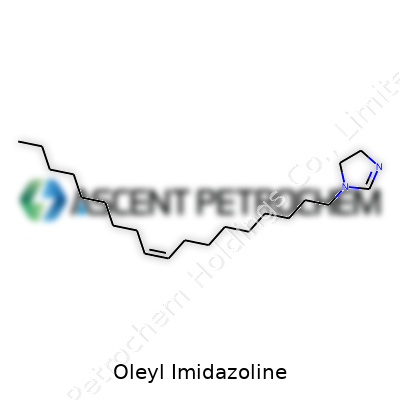
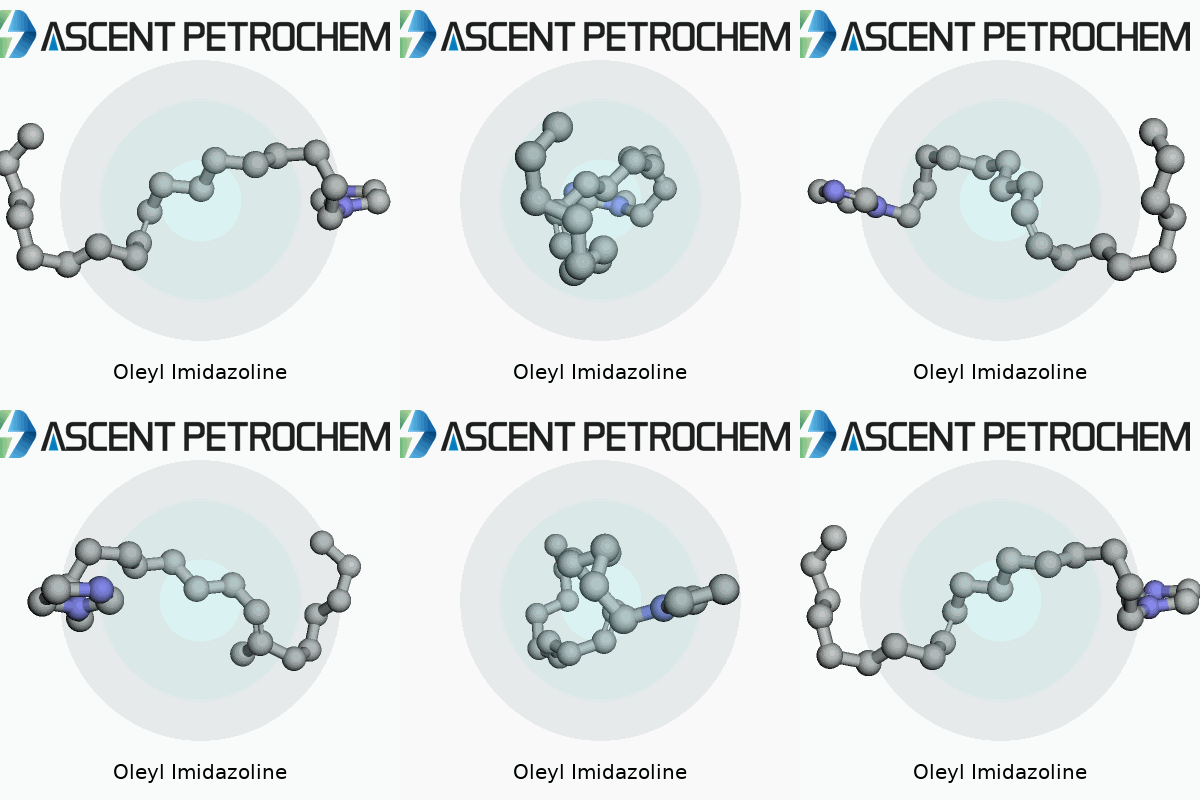
| Names | |
| Preferred IUPAC name | 1-(Octadec-9-en-1-yl)-1H-imidazole |
| Other names |
1-(2-Octadecenyl)-2-imidazoline Oleamidopropyl imidazoline N-Oleyl-2-imidazoline Imidazoline, oleyl Oleylimidazoline |
| Pronunciation | /ˈoʊliːl ɪˌmɪdəˈzoʊliːn/ |
| Identifiers | |
| CAS Number | 95-38-5 |
| Beilstein Reference | 2116656 |
| ChEBI | CHEBI:141100 |
| ChEMBL | CHEMBL608364 |
| ChemSpider | 24736114 |
| DrugBank | DB11274 |
| ECHA InfoCard | 17a853bb-678e-4cd6-ab99-66cdfc93bd51 |
| EC Number | 262-144-9 |
| Gmelin Reference | 58737 |
| KEGG | C16190 |
| MeSH | D017356 |
| PubChem CID | 10772 |
| RTECS number | NR4020000 |
| UNII | QZT9T8Z8S3 |
| UN number | UN3082 |
| Properties | |
| Chemical formula | C21H41N3 |
| Molar mass | 418.73 g/mol |
| Appearance | Yellow to brownish liquid |
| Odor | Amine-like |
| Density | 0.87 g/cm³ |
| Solubility in water | Insoluble in water |
| log P | 3.72 |
| Vapor pressure | Negligible |
| Acidity (pKa) | pKa ~ 7.5 |
| Basicity (pKb) | pKb 2.5 (25°C) |
| Refractive index (nD) | 1.4700 |
| Viscosity | 700 mPa·s (25°C) |
| Dipole moment | 4.56 D |
| Thermochemistry | |
| Std molar entropy (S⦵298) | 810.3 J·mol⁻¹·K⁻¹ |
| Std enthalpy of formation (ΔfH⦵298) | -389.7 kJ/mol |
| Std enthalpy of combustion (ΔcH⦵298) | -15050 kJ/mol |
| Pharmacology | |
| ATC code | C09KA13 |
| Hazards | |
| GHS labelling | GHS07; GHS05; Warning; H315; H319; H335; P264; P280; P305+P351+P338; P337+P313 |
| Pictograms | GHS05,GHS07 |
| Signal word | Warning |
| Hazard statements | Harmful if swallowed. Causes skin irritation. Causes serious eye irritation. Toxic to aquatic life with long lasting effects. |
| Precautionary statements | P264, P280, P301+P312, P305+P351+P338, P337+P313, P330, P332+P313, P362+P364 |
| Flash point | > 180 °C |
| Autoignition temperature | 250°C |
| Lethal dose or concentration | LD50 (oral, rat) > 5000 mg/kg |
| LD50 (median dose) | LD50 (median dose): 2,200 mg/kg (rat, oral) |
| NIOSH | NO3080000 |
| PEL (Permissible) | 50 mg/m³ |
| REL (Recommended) | 0.6 mg/m³ |
| Related compounds | |
| Related compounds |
1-(2-Hydroxyethyl)-2-oleyl-2-imidazoline 2-Oleyl-1-methylimidazoline Oleylamine Oleic acid Imidazoline Cocoyl imidazoline |




