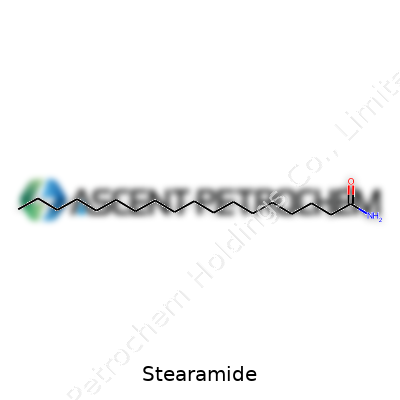
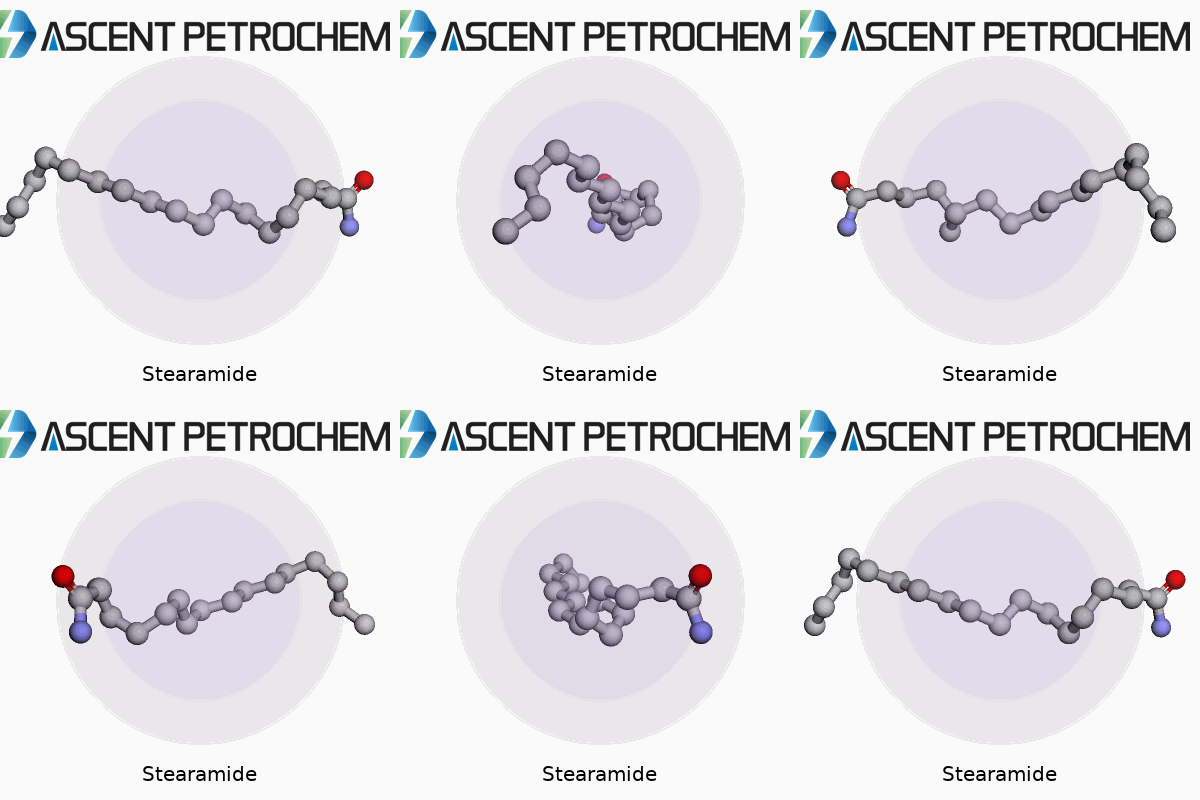
Stearamide has roots stretching back to the late 19th century. Early chemists extracted fatty amides from animal fats, eventually isolating pure stearamide from stearic acid. Its wide industrial adoption paralleled the growth of plastics, rubber, and metalworking. As manufacturing boomed across Europe and North America, this fatty acid amide picked up momentum due to its ability to act as a lubricant and anti-block agent. By the 1960s, manufacturers in the United States and other developed markets had integrated it into their processes, driven by the need for improved mold release and processing efficiency. Stearamide became a staple not by chance but by repeated proof of utility in keeping manufacturing lines moving smoothly.
Stearamide falls into a class of waxy, white solids derived from stearic acid and ammonia. The primary source is often animal fat or vegetable oil, but the chemical’s backbone stays constant. Producers ship it worldwide, chopping it into flakes, beads, or powder forms. Packaging varies from fiber drums to airtight plastic bags, ensuring it stays dry and contaminant-free. Most people never give it a thought, yet it weaves through plastics, rubbers, printing inks, and metalwork shops as a simple additive that quietly solves everyday problems.
This chemical shows up as a white-to-off-white solid. It starts softening above 95°C and melts somewhere near 100–105°C. Unlike many lubricants, it resists water, so it won't wash away in a humid environment. That's partly due to its long hydrocarbon tail—carbon atoms stretching in a tight line, which means it plays nice with both polar and non-polar substances. Its molecular formula, C18H37NO, spells out a hefty structure, resulting in a high molecular weight and a strong, wax-like feel in the hand. Under regular storage, it gives off no smell and stays stable with oxygen and light.
Most suppliers specify stearamide purity above 98%, with moisture content allowed at less than 0.5%. Heavy metals like lead or mercury should not exceed a few parts per million. Certification often ties into ISO or REACH standards, giving downstream users a clear map of safety and sourcing. Drum labels carry batch numbers, production and expiration dates, lot-specific analysis, and recommended storage instructions—generally, keep away from strong oxidizing agents and open flame. Product safety sheets spell out personal protective equipment, fire-fighting measures, and first aid steps.
Manufacturers prepare stearamide by reacting stearic acid with ammonia or an amine under heat in a sealed vessel. This condensation releases water vapors, leaving a raw amide mass. Chemists purify this crude material by repeated recrystallization or solvent extraction before drying it to the desired consistency. Modern production lines automate each stage, monitoring temperature, reactant ratio, and byproduct removal for a product that meets industrial benchmarks every time.
Stearamide participates in relatively few reactions under mild conditions. Its main transformation comes from exposure to strong acids or bases, which can break it back into amines and stearic acid. It mostly plays a supporting role—in plastic processing, it stops surfaces from sticking, but chemically, it stays put. In some labs, scientists tweak the chain length or substitute functional groups to create tailor-made amides for new applications, especially where temperature resistance or electrical properties matter.
In catalogs and shipping papers, stearamide turns up under names like Octadecanamide, Stearic acid amide, n-octadecanamide, or simply fatty acid amide C18. Well-known chemical suppliers might code it as Stearamide 1837 or Stearamide (C18) to highlight purity or side functionalities. Printed ink and plastics manufacturers have their own trade names, but it all boils down to the same chemical backbone.
While not highly toxic, stearamide needs careful handling on industrial scales. It can irritate skin or eyes, especially if powder escapes into the air. Standard operating procedures call for gloves, goggles, and dust masks. Large facilities often use automated delivery to keep fumes and powder at bay. If there’s ever a spill, sweeping it up dry and disposing according to local regulations avoids water pollution. Stearamide’s fire risk stays low, but in thermal decomposition, it releases carbon oxides and nitrogen oxides, so factory floors mandate adequate ventilation and access to fire extinguishers. Workers receive full training as part of regular safety audits, and products always ship with up-to-date safety data sheets.
Walk through any packaging plant, and stearamide plays its part. It sits inside plastic films to keep layers peeling apart without tearing. Rubber goods factories add it to make sure molds let go cleanly, slashing downtime and increasing yield. In the metalworking scene, stearamide acts as a lubricant for wire drawing and pressing, cutting down wear on expensive dies and presses. Other uses show up in ink formulations, where it gives print just enough slip to prevent smudging. Even some cosmetics and personal care goods rely on its waxy feel. Its wide appeal circles back to simple economics: a small dose gives manufacturers smoother production with fewer rejects.
Research never stops pushing stearamide’s boundaries. Polymer science labs explore new blends to improve plastic clarity and toughness, with stearamide taking center stage for anti-block and flow enhancement. Materials scientists probe deeper by grafting additional groups onto the stearamide chain, paving the way for next-generation lubricants with custom melting points or electrical properties. Pharmaceutical analysts look at ultra-pure amides for tablet coatings and controlled drug release. Until now, the biggest breakthroughs spot incremental improvements, because the base molecule already does its job well. Still, as regulations around chemical purity and environmental impact tighten, R&D keeps tuning the synthesis route for higher yield, better recyclability, and reduced waste.
Published toxicity studies point to low acute hazards. Tests on rats and mice found only mild gastrointestinal or respiratory upset from extremely high doses. Workplace exposure at regulated levels shows no clear link to cancer or long-term organ damage, but dust inhalation can aggravate preexisting lung conditions. Data from occupational clinics back up stearamide’s safety record, although strictly occupational hygiene recommendations still stress routine hand washing and local exhaust systems. Regulatory bodies in North America and Europe list it as a low-risk workplace chemical with no significant restrictions beyond common-sense safe handling. On the environmental front, stearamide degrades slowly in soil and water, so disposal through regular trash or incineration works best to avoid water contamination. Long-term studies in amphibians or fish suggest low but detectable accumulation, prompting a closer look at run-off in high-volume manufacturing hubs.
Industry watchlists keep stearamide in sight as plastics and processing technology move toward renewable raw materials. There’s rising demand for plant-sourced and fully traceable fatty amides. Next in line: biodegradable versions for food packaging and single-use plastics. Innovation now runs against a backdrop of global regulatory change, where chemical manufacturers fight for the lowest environmental footprint without losing the reliability of their additives. Researchers eye molecular tweaks to give stearamide better compatibility with bioplastics and recycling streams. The practical reality—factories do not swap out tried-and-true additives lightly, but as costs drop on green alternatives, stearamide could absorb new roles in future manufacturing, especially as markets reward sustainability in every link of the supply chain.
Stearamide isn’t something you spot on billboards or find discussed in buzzing news cycles. Despite its low profile, this waxy substance plays a practical role in products people touch every day. I remember the first time I noticed the term—years ago, my hands were dry after working in a machine shop, and a colleague told me about the “slipping agent” that kept factory equipment running smooth. It turned out that both our jobs depended on stearamide’s ability to reduce friction and improve reliability.
Manufacturers working with plastics appreciate stearamide for a reason. It goes into plastic films, packaging, and even some toys. This material comes from stearic acid, which has a plant or animal origin, and the amide helps keep molded products from sticking to metal. Imagine trying to peel a plastic tray out of a mold only to have it tear or warp—stearamide makes sure that doesn’t happen. The smoother production saves time, energy, and money, which ultimately lowers costs for shoppers at the store.
Rubber plants also use stearamide, adding it to mixes to keep everything flexible without gumming up machinery. I remember poking around a tire shop and noticing fresh treads rolling off a conveyor. The tech on shift told me that, without additives like stearamide, many common hoses and belts would break down well before their time. Better products reduce waste and headaches on the road.
Anyone using crayons as a kid probably enjoyed the smooth glide across paper without thinking twice. Stearamide often finds its way into coloring wax because it helps colors melt evenly and avoid clumps. Some candles and polishes rely on it for a cleaner finish that doesn’t flake or smudge too quickly.
Many cosmetics use this ingredient to stabilize creams and lotions, keeping skin feel pleasant instead of greasy. In my house, we pay attention to labels since sensitive skin can react to everything. Products listing stearamide tend to be less likely to irritate, as it supports consistency and keeps formulas from separating. The FDA regards it as safe in low concentrations, but checking for proper certification and responsible sourcing remains important.
Although most studies haven’t shown major risks from stearamide at levels common in consumer goods, the source matters. Some manufacturers still rely on animal fats, raising ethical and allergy concerns. Customers looking for vegan products sometimes find themselves combing through ingredient lists for peace of mind.
Waste management also deserves attention. Microplastics and industrial runoff continue to generate headlines as researchers study long-term effects on waterways and wildlife. Additives like stearamide don’t make up the bulk of plastic or rubber trash, but they’re a signpost for how small tweaks in the supply chain can ripple out. Producers searching for plant-based or recycled feedstocks could offer safer paths forward.
Most people don’t get the chance to weigh in on which slip agent factories choose, though demand for eco-friendlier chemicals keeps climbing. Learning what’s in common items doesn’t just help scientists or engineers—it empowers consumers and parents making daily choices. Pushing for clear labeling, sustainable sourcing, and open communication creates trust, both on store shelves and in larger supply chains.
You probably haven’t heard much about stearamide, but you’ve touched it. This waxy compound, made from stearic acid, shows up in creams, lotions, soaps, and makeup. It helps keep products smooth, stops powders from clumping, and acts as a slip agent. Manufacturers like it because it delivers stability and a silky texture without a strong scent or color.
The conversation about what goes on the skin always sparks debate, especially for folks like me with sensitive skin. Stearamide isn’t a name that triggers alarm bells among dermatologists. Both the U.S. Food and Drug Administration and the Cosmetic Ingredient Review Expert Panel have reviewed its use. The CIR, for instance, evaluated studies on its absorption through the skin and its potential for irritation. At customary concentrations—often less than 2%—the compound doesn’t appear to cause harm.
I remember trying a moisturizer with a long ingredients list and worrying about the names I’d never seen before. Like many, I wondered: Will this irritate my skin? Research offers some comfort. Patch tests and clinical trials do not link stearamide to common allergic reactions. According to large consumer safety groups, including the Environmental Working Group, it falls into a low-risk zone when used topically.
Not every skin is the same, though. I’ve had friends tell me they have breakouts or redness after trying a new cream, and sometimes it’s tough to pinpoint the cause. Dermatologists agree that rare individuals may experience sensitivity to even common ingredients. A careful look at the label and patch-testing on a small area can help avoid issues, especially for those with allergy-prone or very reactive skin.
Sometimes, online forums stir up anxiety about chemicals in cosmetics. Some posts link stearamide to more serious health concerns, like hormone disruption or cancer. I dug into those claims, and there’s no credible peer-reviewed science behind them. Regulatory agencies in North America and Europe haven’t flagged stearamide as a concern when applied to the skin.
Even with no glaring evidence of harm, companies must keep reviewing safety data. Ingredient safety isn’t a one-time question. Consumers don’t just want assurance—they expect transparency about where ingredients come from and updates on long-term effects.
Manufacturers that care about consumer trust can do a better job explaining sourcing and safety testing. Offering products with fewer unnecessary additives may help those looking to avoid extra chemicals altogether. For people worried about irritation or allergies, patch tests and clear, ingredient-focused labeling are practical solutions. Dermatologists can give advice on what to use by looking at ingredient lists and listening to personal experiences.
Choices about skin care get personal fast. People like myself scan ingredient lists and share stories about what works and what stings. Stearamide hasn’t stood out as a troublemaker in years of research, and trustworthy scientific bodies back up its use at today's levels. That doesn’t mean everyone will have the same experience. Trying a product on a small patch of skin, checking in with a dermatologist, and staying updated on new research offers peace of mind. Doing a little homework pays off if it means avoiding an itchy rash or wasted cash.
Walk through a plastics factory and you’ll find stearamide everywhere. Low friction is key in plastic processing, so stearamide finds its way into extrusion lines, injection molding machines, and lots of packaging operations. It acts as a lubricant, helping pellets and molten resins slide farther and faster, which means faster production and fewer rejects. Think of your everyday food wrap, bottles, automotive clips, and even electrical insulation—the slick finish and easy demolding often owe their thanks to this single fatty amide.
Tires, weatherstripping, gaskets, shoe soles—rubber needs efficient molding, and sticky molds slow the whole show. By sprinkling stearamide into rubber batches, manufacturers avoid the worst of the sticking and tearing. Factories see fewer defective parts and longer-lasting equipment. Asphalt mixing plants lean on it, too, since its anti-blocking properties keep sticky materials from bunching up or clogging machinery.
Stearamide steps in to boost quality control behind the scenes in both ink and paint. Printers and packaging plants rely on it to cut down static, so that papers don’t cling and jams are less frequent. The pigment blends more evenly, leading to a smoother look. Paint manufacturers add it for its slip properties, so surfaces resist scuffs after the paint dries. Less static and easy flow matter when you’re running big jobs and tight production deadlines.
Clothing runs softer and smoother through industrial machines, in part because of stearamide. Textile makers add it during processing to keep fibers from sticking together, which results in fabrics that don’t pill as easily. Stearamide gives synthetic fibers a silky feel, and even assists dyes in spreading more evenly across tough-to-treat materials. In my own work sorting through textile samples, batches treated with stearamide handled better and finished with better texture.
Glue sticks, labels, tape—all of these benefit from the anti-block effect. Stearamide’s waxy texture keeps adhesive sheets and layers from clumping in storage. Portable adhesives sometimes melt when things heat up in transit or on shelves, but stearamide shows its real value by avoiding waste and jams. Factories save money on packaging, since less scrap means more product making it to market.
From lipstick tubes to skin creams, stearamide plays its part behind the scenes. It keeps makeup from clumping, creams from separating, and helps powders flow easily into compacts. Even pomades and stick deodorants depend on a little help from this fatty amide, giving them smooth application and longer shelf life.
Direct food contact needs extra attention, since not every chemical passes safety standards. Stearamide gets used in things like bread bags and snack wrappers. The anti-blocking effect stops thin films from sticking together, so machines can tear and fill packages without snagging. This cuts down on wasted packaging material and keeps lines running.
The reach of stearamide across so many industries goes to show how small chemical tweaks can deliver real benefits. Manufacturers can boost productivity, cut down on defects, and get consistent quality—all with help from a molecule most folks never think about.
Stearamide stands out as a waxy solid at room temperature. If you pick it up, it feels smooth to the touch, almost slippery. The color tends toward white or a slight off-white, and manufacturers appreciate its stability. This material doesn’t just melt at the drop of a hat; you need a temperature above 100°C to turn it into a liquid, with the melting point falling between 100°C and 105°C. You won’t see stearamide dissolve in water, no matter how long you stir it. On the other hand, it dissolves quite well in oils or hot organic solvents, which makes it suitable for plastic, rubber, and even printing ink factories. Presence of a faint, fatty odor sometimes lingers, a detail you notice when handling it in bulk.
Chemically, stearamide carries the formula C17H35CONH2. It forms when stearic acid meets ammonia or an amine tone in a controlled environment, creating an amide bond. You’ll never see it react violently or degrade into something harmful under standard processing conditions—stearamide remains calm and predictable. It avoids easy breakdown in the presence of light and air, shunning the yellowing and oxidation that plague other additives. Some folks forget how important this is for useful shelf life. Plastics and rubbers won’t discolor, and that means fewer headaches for quality control teams down the line.
Stearamide doesn’t mix with water, and it shrugs off most acids and alkalis. That resistance keeps it stable in a long list of applications, especially where repeated exposure to chemicals might otherwise ruin performance. I’ve seen it used as an anti-blocking and slip agent in plastic films. It spreads out and forms a gentle barrier that keeps finished sheets from sticking together. Without that feature, packaging films would be plagued by static and clinging problems, leading to slower machine speeds and operational delays.
People like me who’ve spent long days on the production floor learn to appreciate stearamide’s steadiness. You never have to watch your material crumble under heat or lose performance in a humid warehouse. Its waxy structure lets it act as an efficient lubricant—not just for plastics but for metalworking as well. In injection molding, the right slip agent can mean the difference between jamming up a high-cost mold or keeping production humming. In the color masterbatch industry, its oil-loving character helps spread pigments more evenly, cutting down on wasted product and complaints from customers. Each point ties back into real-world consequences: fewer rejects, lower downtime, happier clients.
Not every story is positive. With widespread industrial use, questions come up about health and safety. Research on stearamide has so far painted a reassuring picture. It doesn’t build up in the body or prove toxic at the workplace concentrations you’d see in plants or labs. Still, inhaling the powder day in and day out can bother the lungs or skin if you’re not careful. Gloves and dust masks can handle that risk, and facility managers keep those rules clear. Disposal follows standard guidelines, mostly because it resists breaking down quickly in nature. More companies are working on tighter cycle management to keep it out of waterways, reflecting broader pushes in green chemistry.
Stearamide isn’t magic, but it’s reliable—an unflashy piece of modern manufacturing that holds several industries together. Firms looking to cut waste now consider recycling stearamide from production scraps. Some research labs focus on bio-based sources, aiming to move away from petrochemical feedstocks. We’re not there yet, but industry demand for safer, sustainable processes keeps the ball rolling.
Anyone who’s spent time in a lab or factory knows sloppy storage turns simple jobs into big headaches. Stearamide, a waxy solid often used as a slip agent or lubricant, has its quirks. If left out, it attracts dust and grit, and heat turns it into a sticky mess that clogs machines and ruins consistency. I remember working with fatty acid amides in a midwestern plastics facility. We learned the hard way that careless handling ruins not just the raw material, but the entire batch downstream.
Keeping stearamide dry and cool doesn’t just protect the chemical, it avoids safety problems and stops wasted money. Moisture leads to clumping that blocks feed hoppers, and dirty product invites unnecessary contamination. At a plant I toured, loose discipline led to product recalls—inventory sat too close to an open loading dock. One rainstorm and pallets of poorly wrapped stearamide picked up enough humidity to turn them useless. Good storage prevents headaches like this. Clean product cuts down on machine wear and keeps end users happy.
Storing it below 30°C (about 86°F) keeps it stable and easy to handle. Higher temperatures soften the waxy solid and make spills or lumps far more likely. Most busy sites use ventilated, shaded rooms or climate-controlled spaces, keeping the product on pallets to guard against damp floors. Strong, sealed bags or drums work best—especially those with a good liner. Closed packaging means the stuff keeps fresh and avoids pulling odors or fumes from other chemicals nearby.
The main problem with stearamide is dust. Pouring from bags or shoveling powder stirs up fine particles that irritate eyes and throats. No one wants to spend a shift coughing or running for eyewash. Simple goggles and dust masks cost next to nothing and keep people comfortable. I’ve seen plenty of folks try to skip protective eyewear, only to regret it mid-shift.
Gloves make sense, too. While not especially hazardous, stearamide can dry out skin or make it slick to the touch—hardly a recipe for safe work. An old-timer I worked with always said, “Keep powder off your hands, and it’ll keep out of your mouth.” His advice stuck with me, and it holds for stearamide.
Most problems pop up not from the chemical itself, but from people guessing at the right steps. Handing workers clear, specific instructions goes a long way. Post basic storage rules on dispensary doors. Run refresher training every few months. Make sure new hires get walked through the right way to move, scoop, and reseal containers. I once watched a supervisor stop a spill in its tracks—instead of scolding, he walked the crew through a better transfer method, and that plant ran smoother from then on.
Industrial scoops, grounded hoses, and properly labeled bins might seem like small details, but they pay off. A friend working in a color masterbatch firm said updated scoops did more to cut downtime than any expensive process control system. Label every drum and use sturdy pallets. These small fixes save money by averting mistakes, cleanup costs, and rework.
Handling stearamide safely isn’t rocket science, but it takes common sense and a bit of discipline. Clear rules, basic safety equipment, and some organization prevent most mishaps. In my experience, a well-organized stockroom and a well-trained crew make all the difference. That’s true for stearamide—and just about anything else you store or use in an industrial setting.