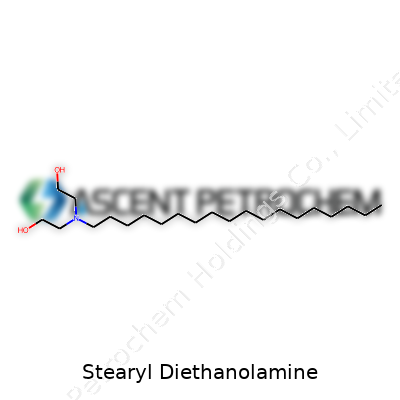
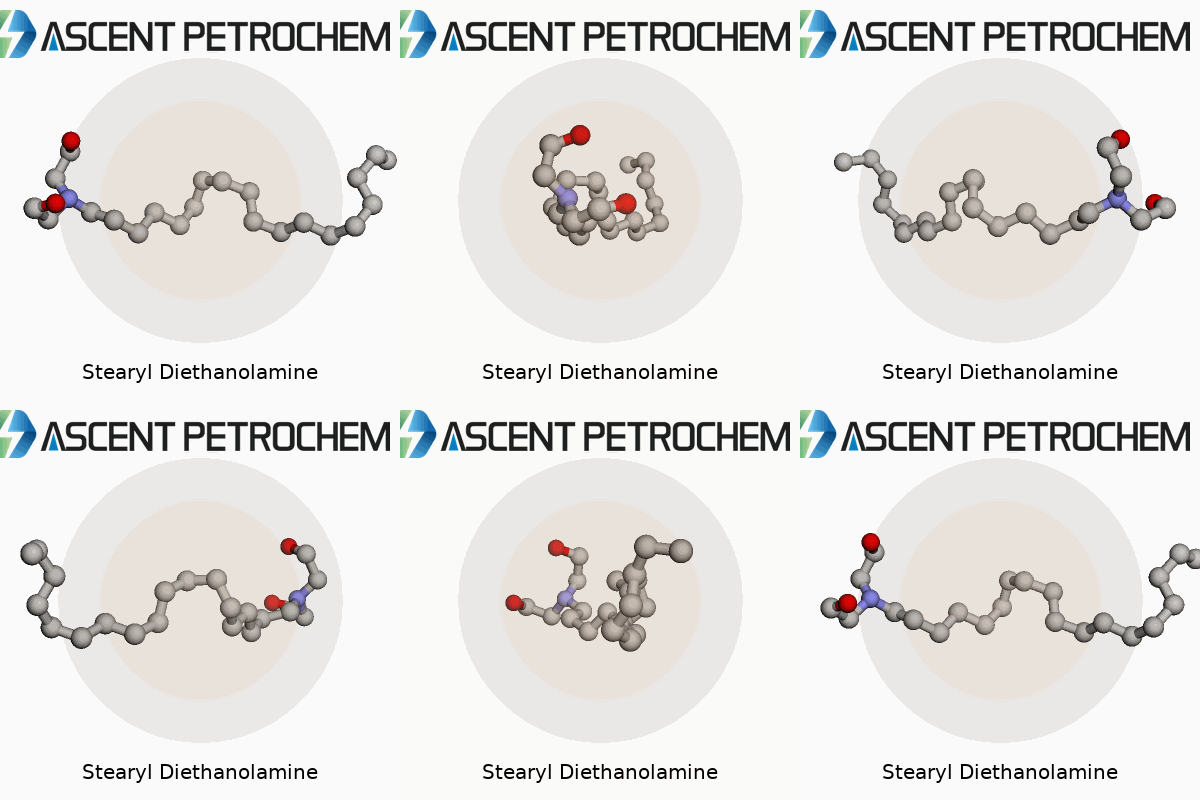
Stearyl diethanolamine didn’t just pop up overnight. Chemists have been tinkering with fatty amine derivatives like this one for decades, with early applications showing up in the mid-twentieth century thanks to greater access to pure fatty acids and ethanolamines. In the postwar era, manufacturers looked for stable emulsifiers and surfactants that could handle soaps, creams, and oil-water mixtures without turning chaotic in the bottle. Big companies in personal care and cleaning products figured out early on that modifying long-chain fatty acids, such as stearic acid, with diethanolamine gave products much better creaminess, less separation, and a skin-friendlier touch. As more disposable income grew the awareness for specialized products, industry steadily leaned into molecules like Stearyl diethanolamine, both for function and the psychological comfort of “milder” ingredient lists.
Stearyl diethanolamine, often described by chemists as a non-ionic surfactant, lives in a world packed with alternatives, yet it draws loyal support from formulators. Its backbone comes from a simple reaction between stearic acid, a fatty acid you see in many animal and vegetable fats, and diethanolamine, an organic compound easily purchased in bulk. The final product consists of a waxy, white-to-pale-yellow solid with a faint odor, and this bulk form ships in drums or bags for industrial settings. Small-scale cosmetic producers, especially those crafting private label shampoos or gentle cleansers, often extol this ingredient’s ability to turn harsh detergents into creamy, pleasant formulas people actually want on their skin.
Talking texture, Stearyl diethanolamine shows up as a waxy substance at room temperature, softening as warmth rises. As for melting points, the industry cites a tight range around 60–70 °C. The molecule offers decent solubility in hot water and alcohol but resists dissolving in cold aqueous solutions; it wants a little heat before it behaves well. Its chemical structure combines two ethanolamine units tacked onto the stearyl backbone, which shapes its amphiphilic personality: loving both water and oil, refusing to pick just one. This helps it blend stubborn mixtures in ways that beat out simpler soap molecules. The pH value for a typical 1% aqueous solution will hover between 8 and 10, which means it leans gentle, away from the burns and stings of harsher chemicals.
Technical data sheets spell out that good Stearyl diethanolamine should deliver a high assay—often upwards of 98% purity—with limits set for residual stearic acid, water, and free diethanolamine. Manufacturers test for melting range, color (often checked by Hazen or APHA scales), and amine value. If you squint at a product label of a cream or shampoo, you might notice plenty of variations: ‘Stearamide DEA’ or simply ‘Stearyl DEA.’ Cosmetic regulations, especially in places like Europe, push companies to clearly declare both the INCI (International Nomenclature Cosmetic Ingredient) Name and the function, such as “emulsifier” or “foam stabilizer.” Consumers, increasingly ingredient-savvy, demand this transparency.
Industrial synthesis of Stearyl diethanolamine follows straightforward routes: manufacturers heat up stearic acid together with a calculated quantity of diethanolamine, typically in batch reactors. They drive off the water that forms during this condensation, sometimes under reduced pressure, to shift the reaction toward the amide product. Left unchecked, the process can yield a mess of byproducts, so clever control of temperature, ratio, and removal of side-water matters a lot. Waste streams get managed to shave off costs and protect downstream waste handling—clean chemistry always loops back to dollars and environmental footprint.
On its own, Stearyl diethanolamine stands up to reasonable acids and bases, making it fit well for products with broad pH demands. Exposing it to strong acids can hydrolyze the amide bond, eventually breaking it down into its building blocks, but under regular use in gentle products, it holds together. In the lab, chemists often take this backbone as a starting point, attaching other fatty acids or tinkering with the ethanolamine group to produce specialized surfactants for demanding performance needs. Modification, through things like ethoxylation, can push its functionality into areas such as fabric softeners or more esoteric personal care applications.
Across the chemical trade and among different country regulations, Stearyl diethanolamine wears many hats. Its most common synonyms include Stearamide DEA, N,N-Bis(2-hydroxyethyl)octadecanamide, or even more pharmacist-sounding names like Octadecanamide, N,N-bis(2-hydroxyethyl)-. International brands follow INCI rules, so most cosmetic labels pitch “Stearamide DEA” front and center, while industrial supply catalogs nod to CAS number 10213-78-2 for exact identification. Every so often, specialty chemical firms market blends or high-purity batches under their own trade names, but the backbone chemistry stays recognizable to industry pros.
Working with Stearyl diethanolamine doesn’t set off the alarm bells that some amines do, yet it asks for careful handling. Like other ethanolamines, spill cleanup should include gloves and good ventilation—a little caution staves off skin and respiratory irritation. Acute toxicity for straight exposure lands on the low side, but the real concern these days revolves around byproducts and degradation. Diethanolamine itself, under certain conditions, may react with nitrosating agents to form nitrosamines, which show up in research as potentially carcinogenic. Smart manufacturers minimize free DEA through process control and regular testing; regulatory bodies such as the European Commission and U.S. FDA watch this closely to clamp down on unsafe levels in both raw ingredients and finished goods. It’s another example of how process and paperwork connect to real public health risks.
Application remains the real reason anyone pays attention to Stearyl diethanolamine. Long-time formulators know its uses inside cosmetic creams, shampoos, and bath gels, where it stabilizes foam and helps disperse oils throughout water-based products. Cleaning products, both domestic and industrial, also lean on its balance: it lets detergents lift grease while softening the touch—cracked hands and scalp itch get less common in formulas using this ingredient. Beyond that, Stearyl diethanolamine ends up in textile softeners and lubricants, acting as a mild anti-static agent. Small craft operations, from “all-natural” soapmakers to boutique cosmetics labs, use it to give their products a texture that feels both pleasant in use and easy to manufacture.
In research departments, the conversation around Stearyl diethanolamine has shifted a bit in the last decade. On the technical side, scientists keep testing out ways to make the synthesis greener—less solvent, fewer emissions, and reduced reaction time. Meanwhile, the push for “safer, cleaner” labels motivates the hunt for alternative feedstocks, such as sustainable palm stearic acid or plant-sourced ethanolamines. On the application side, R&D groups keep working at finding the sweet spot between performance and regulatory acceptability, picking apart structure-activity relationships to maximize its benefits while sidestepping any health worries tied to byproducts. Increasingly, startups look to see if this molecule’s backbone can take on new roles, maybe as a carrier for actives in skincare or as part of biodegradable cleaning agents.
Toxicity questions lurk around many amine-based surfactants, and Stearyl diethanolamine is no exception. Animal studies and cell culture tests have mostly pegged the raw material as having low acute toxicity—large doses are needed before harmful effects show up. The debate heats up around possible long-term risks, mainly because the diethanolamine fraction, especially when free or partially reacted, can associate with nitrosamine formation under nitrosation. Both European and American regulators urge manufacturers to keep levels of free and secondary amines as low as possible and to confirm raw materials don’t give off measurable nitrosamines under normal use conditions. Oncology researchers watch this space; honest reporting by firms on “trace” contaminants helps build trust and safety margins for the public at large.
People in the industry don’t see Stearyl diethanolamine going anywhere soon, despite ongoing debates over safer, green chemistry. Cosmetic and cleaning product designers rely on it to keep up with consumer demand for products that clean well while feeling gentle and stable in the hands. Ongoing research into alternative crops for fatty acid sources, and pushes by regulators pushing down the bar for hazardous byproducts, will likely steer future production. Some see potential in modifying the base molecule further, making “hybrid” surfactants to target completely biodegradable cleaning agents—maybe moving a step closer to full sustainability. For now, the industry keeps a close watch on performance improvements and the slow march of regulatory shifts. Real progress on purity, handling, and sourcing will decide whether Stearyl diethanolamine’s next chapters look as promising as its track record so far.
Stearyl diethanolamine shows up in places most people wouldn’t expect. The chemical helps shampoos foam and lotions glide smoothly onto your skin. In the world of cosmetics and personal care, it acts as an emulsifier and surfactant. This means it helps oil and water mix together, giving many of our favorite products their creamy feel. It slides easily into soaps, face creams, conditioners, and even shaving products. That pleasant, stable texture in your hand often relies on chemicals like this one.
If you peek into the cleaning aisle, you’ll also spot it on labels for household detergents and industrial cleaners. Businesses value its ability to blend grease, water, and dirt, so grime washes away without much scrubbing. Factories add it to their processes, too, making use of its properties to keep things moving or to keep ingredients from separating. It isn’t a household name, but it’s right there in many bathrooms and kitchens.
People have a right to wonder how safe chemicals in daily products really are. Some research shows stearyl diethanolamine can cause mild skin irritation, especially at higher concentrations. The American Contact Dermatitis Society lists it among possible skin sensitizers. For those with eczema or sensitive skin, this could be more than a mild annoyance. Science journals mention its presence in trace amounts doesn’t register as a health threat to most people. Still, questions pop up when you see more complex names among ingredients.
Another factor that keeps experts watching this chemical closely: under certain conditions, stearyl diethanolamine can combine with other ingredients and form nitrosamines. These have shown links to cancer in animal studies. Regulatory agencies such as the U.S. Food and Drug Administration keep tabs on these risks. Brands toe strict lines to keep nitrosamines at safe, trace levels—or eliminate the conditions that form them. Nobody wants health risks in their soap or lotion, even by accident.
Better labeling goes a long way. I’ve seen complicated ingredient lists confuse even the savviest shopper. We need packaging that doesn’t tuck chemical names away or hide them behind jargon. Making it clear why a chemical appears in a product and what role it plays gives folks more choice and control. When I reach for a shampoo, I want to know what I’m putting on my scalp.
Encouraging research into safer, plant-based alternatives feels like a smart move for industry and consumers alike. These days, more companies strive for “clean” and transparent formulas. Choices like coconut-derived surfactants or shea butter emulsifiers already make waves in the market. When possible, helping smaller brands access new technology could ramp up adoption of gentler ingredients and sideline chemicals with a history of irritation.
Regulators can keep rules up-to-date, so formulas follow the latest science. None of us can check every paper or conduct every study ourselves. That’s the role of oversight—protecting health, while companies keep making products that feel good, work well, and inspire trust. My own experience shows people return to brands that don’t just chase trends, but build real transparency and safety right into their products.
Flip over a bottle of shampoo or moisturizer, and you might spot a long, tongue-twisting ingredient: stearyl diethanolamine. It’s in the formula to make creams thicker or help shampoo foam up into that lather everyone loves. Most folks never notice it’s there, but some people have started to wonder if it’s safe to spread across skin or rub into their scalp every day.
Using something daily that builds up on the body brings up some fair questions. My own time digging through ingredient lists and scientific studies puts safety at the top of my mind, because I want to know just as much as anyone else whether what I’m using brings risk. Stearyl diethanolamine falls under a class of chemicals known as ethanolamines. These ingredients get flagged sometimes because certain forms — especially when mixed the wrong way or exposed to certain preservatives — can turn into nitrosamines, which scientists have linked to cancer in lab animals.
A couple of decades back, the International Agency for Research on Cancer (IARC) warned about nitrosamines in cosmetics. These warnings led regulators in places such as the EU to crack down. Europe has stricter rules, and they don’t leave much room for error if there’s a chance ingredients will form unsafe byproducts. Over in the United States, the FDA doesn’t outright ban stearyl diethanolamine, but companies are supposed to keep levels low and avoid mixing it with certain substances known to trigger nitrosamine formation.
Research into the direct effects of stearyl diethanolamine itself, not just its possible breakdown products, paints a murkier picture. Animal testing shows irritation at higher doses on sensitive skin, but the concentrations used in most shampoos and lotions lands far lower. The Cosmetic Ingredient Review panel, which investigates these things in the US, once concluded that small amounts don’t seem to bother most people’s skin. Still, folks with more sensitive skin or with allergies might notice itchiness or redness around areas that get the most product buildup.
Concerns rise when companies mix a bunch of different ethanolamines and nitrosating agents together, or store products in heat or strong light for a long time. More testing would help, especially long-term human studies, but for now, cosmetic regulators keep insisting that low levels don’t seem to cause severe health problems.
I’ve spent years trying different products, from the drugstore budget lines to the most expensive brands on boutique shelves. People with sensitive skin, allergies, or just personal preferences sometimes benefit from skipping complicated, multi-syllable additives. Plenty of stores now carry stearyl diethanolamine-free lotions and cleansers for anyone who wants to play it safe. Reading ingredient lists carefully and looking for brands willing to explain exactly what they use gives more control.
Producers could help by being honest about sources and testing of their raw materials. Labels rarely talk about the risk of chemical changes during storage, but those behind each formula know more than anyone else where problems might begin. To lower risk for everyone, companies can cut back on the combinations likely to cause nitrosamines, and share their safety data so buyers aren’t left trusting anonymous scientists or marketing claims alone.
People deserve to know what’s in their daily products and how those ingredients work over time. Stearyl diethanolamine may not bring major risk for most people, but checking for the ingredient and sticking with simpler formulas never hurts. Fewer chemicals mean fewer things for your skin to react to, and fewer chances something will go wrong. Real safety comes from understanding, clear information, and support for better testing, not just hoping big words on bottles mean little risk.
Stearyl diethanolamine shows up in plenty of places: shampoos, lotions, and conditioners. People who care about vegan and cruelty-free products want to know—what’s this stuff actually made from? The answer sounds simple but the reality brings a lot more layers than most shoppers expect.
The “stearyl” part gets its name from stearic acid. Stearic acid exists in both animal fats and some plant oils, such as coconut oil or palm oil. On the surface, that means it can be made vegan or animal-derived. The trouble is, cosmetic and personal care brands usually don’t state the original source. That leaves space for uncertainty if you’re tracking every ingredient in your routine.
Chemists create stearyl diethanolamine by reacting stearic acid with diethanolamine, which is synthetic. While the chemical steps look routine at first, the real issue lies in the source of the fatty acid. Companies can buy stearic acid made from any source that’s available or affordable at the time: plant-based, tallow, or a blend, unless they've committed to plant-only. Animal-derived stearic acid starts from slaughterhouse byproducts. Many large-scale soap and cosmetic factories once relied on beef tallow, because it's cheap and abundant.
Ingredient lists won’t always spell out “derived from animal fat” or “coconut sourced.” For a vegan, this creates a guessing game. Unless a brand commits to vegan certification, shoppers don’t have a way to know for sure. In big-box beauty products and supermarket brands, cost often wins out over ethical sourcing.
On the flip side, I’ve seen some niche or indie brands proudly announce the origin of their fatty ingredients—sometimes even on the front of the bottle. This isn’t the norm. Most labels require a detective’s eye. For example, if a product claims to be “100% plant-based” or carries a recognized vegan certification, you can trust the stearyl diethanolamine is plant-derived. Short of that, even customer service sometimes won’t provide a clear answer, which leaves vegans frustrated or just moving on to alternatives.
If you care about ingredients due to ethics, allergies, or environmental reasons, this uncertainty forces tough choices. For a vegan, animal derivatives in soaps or lotions bring up real concerns. This isn’t just about a bottle of shampoo; it reflects the challenge of making conscious purchases in a world focused more on mass production than transparency. Even for those not strictly vegan, plant ingredients often have a smaller carbon footprint, which matters for anyone keeping sustainability in mind.
What helps most is better labeling and transparency. If brands listed sources as clearly as they listed “fragrance,” shoppers could make quick, confident decisions. Instead, people contact companies or look for third-party certifications like Leaping Bunny or the Vegan Society logo. Those matter far more than simple label reading, because they show a commitment to animal-free ingredients at every step, not just marketing.
As consumers keep asking questions, more companies are moving toward plant sources by default. Pressure from buyers encourages brands to shift and tell the full story. In the meantime, anyone avoiding all animal products needs to watch product claims closely and stick to brands that prioritize clear, honest ingredient sourcing.
Stearyl Diethanolamine shows up on the ingredient lists of common household products, especially shampoos, conditioners, and liquid soaps. Its role in these items isn’t complex: it helps create that creamy texture and stable foam most people expect in their daily routine. For folks with no sensitivity, it just fades into the everyday rinse. But it makes sense to ask: what could happen to those who do not handle this ingredient well?
Most people never notice anything different after using products with Stearyl Diethanolamine. Others may face issues, and these typically fall into skin reactions—think redness, itching, mild burning, or swelling. Sometimes these symptoms look like a typical case of contact dermatitis. Research points to the fact that sensitive skin and existing conditions like eczema can raise the risk of irritation. Health professionals see this more often in folks who already get rashes from other soap or shampoo ingredients.
A handful of scientific studies investigated reactions to diethanolamines as a group rather than Stearyl Diethanolamine alone. The American Contact Dermatitis Society has flagged some diethanolamine compounds as low-level sensitizers. Patch testing in dermatology clinics has shown occasional positive reactions, though much less so than with other common allergens like fragrances or preservatives.
Beyond itchy skin, another layer of concern comes from potential long-term effects. Some researchers have raised questions about diethanolamine compounds interfering with the skin’s protective barrier or even with nutrient absorption in rare cases. Animal studies have looked for links to carcinogenic risks, especially since diethanolamine can, under certain conditions, form nitrosamines—a class of substances linked to cancer in animal tests. The U.S. Food and Drug Administration and the European Commission have both published guidance on limiting nitrosamine contamination in consumer goods, but regulated use and proper manufacturing curb that risk.
In my own experience talking with dermatologists, the advice stays consistent: those with sensitive or broken skin need to read ingredient lists and watch for new symptoms. For most consumers, infrequent and brief exposure, like washing your hair or hands, is not likely to cause long-term issues.
Cosmetic companies and regulators have pushed limits on how much diethanolamine-based compounds— including Stearyl Diethanolamine—can go into products meant for skin contact. This comes from the need to reduce both allergy risk and possible nitrosamine formation. Companies have options to use alternatives if allergies become an issue among their consumers. The FDA, European authorities, and watchdog groups like the Environmental Working Group continue to monitor new research and update safety recommendations. Transparency about ingredients helps consumers make informed choices, especially for people with a track record of sensitivities.
Anyone noticing a rash, redness, or discomfort after using a product should stop use and check the ingredient label. If the irritation fades after switching, speak with a doctor or pharmacist to confirm if Stearyl Diethanolamine could be the trigger. Allergy patch testing can pinpoint the source. For those managing conditions like eczema or allergies, fragrance-free or “hypoallergenic” products may work better. Brands labeling their formulas and providing clear ingredient breakdowns make this process easier for everyone looking to avoid issues.
Knowing what’s in your daily products and listening to your body stands at the center of good self-care. If sensitivities crop up, options exist. Advocacy for better ingredient labeling and ongoing research helps keep everyone safer, regardless of their individual skin type.
Stearyl diethanolamine isn’t a name that rolls off the tongue, but you’ll find it in more lotions, shampoos, and conditioners than you’d expect. It gets added for a reason: it helps oil and water blend. Oil and water naturally separate—anyone who has made a salad dressing knows this. In personal care products, nobody wants to shake a bottle every time or find an oily layer on top of a cream. Stearyl diethanolamine gets the job done by working as an emulsifier, making silky, even-textured products.
Product developers pick stearyl diethanolamine because it lets them mix ingredients easily. It keeps creams thick and stable for months on end, holding together when you toss them in a bag or leave them in a warm bathroom. A product that separates looks low-quality and isn’t easy to apply, so this ingredient matters on a practical level. It also helps make things feel smoother during application, which can nudge consumers to use a product more consistently. As someone who’s seen old lotion bottles clump or separate after a few weeks, I appreciate that steady texture.
Each year, consumers get more interested in what goes into their cosmetics—and for good reason. Manufacturers and safety boards in the US and Europe have reviewed the research on stearyl diethanolamine. Data shows low risk when used as directed. The molecule is too large to pass through healthy skin in significant amounts, so concerns about irritation are minor for most folks. So far, I haven’t found clear links between this ingredient and major side effects in regular use. But that doesn’t mean ignoring ingredient lists is wise. People with sensitive skin or allergies should always patch-test new products.
I see two angles that often come up. Some worry about the buildup of ingredients like diethanolamine compounds in the environment. Wastewater from production can put these molecules into local water supplies, where they may break down slowly. Regulatory groups keep an eye on this and sometimes recommend formulas that lower the content or swap out certain chemicals for greener alternatives. Another issue ties to sourcing. Ethical sourcing is a rising concern—whether palm oil or other raw materials used for the “stearyl” part cause environmental harm. Responsible companies look for responsibly harvested ingredients and are transparent about their supply chain.
As someone who values both product quality and environmental impact, I see room for improvement. Brands can prioritize updated research on ingredient safety and look for naturally derived alternatives or sustainable sourcing wherever possible. Regulatory bodies, like the Cosmetic Ingredient Review and the European Commission, can keep pushing for honest labeling and safer formulations as new data comes in. For those making products at home or running a small batch operation, it helps to stay informed and pick ingredients you trust. For everyday shoppers, small choices—choosing brands that post safety data and care about ingredient sourcing—have power in shaping what ends up in our cosmetics.