Tetrabutylammonium acetate didn’t emerge from thin air; its story traces back to the growth of phase-transfer chemistry and ionic compound research, where researchers sought alternatives to more cumbersome inorganic salts. The twentieth century saw labs shift focus from traditional alkali metal salts toward quaternary ammonium salts. Scientists realized that swapping bulky alkyl groups onto the ammonium center raised solubility in organic solvents—a lightbulb moment for green chemistry routes. Tetrabutylammonium acetate joined the scene as organic synthesis branched out, demanding milder, more versatile bases and phase-transfer catalysts. After the 1960s, chemical supply catalogs started listing this compound, and demand has only grown with the rise of specialty chemicals, analytical reagents, and new synthetic methodologies.
I see Tetrabutylammonium acetate as more than just a white powder or crystalline solid; it’s a toolkit component, valued for its ability to shuttle acetate ions into places that ordinary acetate salts can’t reach. Its popularity grows in labs synthesizing organics, running advanced catalysis, or extracting nucleic acids. Commercial sources package it as a solid, free-flowing salt or a solution in polar solvents, making life easier for anyone needing precise concentrations or faster solubility. It isn’t a one-trick pony—chemists keep finding more uses whether they’re tinkering with phase-transfer reactions, improving chromatography separations, or developing milder reaction conditions for sensitive molecules.
From my experience, its standout features stem from its structure: a hefty tetrabutylammonium cation pairs with a flexible acetate anion. Its pure form appears as a white to off-white solid and sports impressive solubility in most organic solvents like methanol, acetonitrile, and DMSO. Melting points hover between 100°C to 120°C, which feels high enough for stability but low enough for easy handling during syntheses or recrystallizations. Unlike sodium or potassium acetates, this salt dissolves readily in both polar and moderately polar solutions, where its large organic cation disrupts crystal packing and drives up solubility. Anyone who’s worked with sluggish salt dissolution notices the difference immediately—no need for endless stirring or heating.
Manufacturers list Tetrabutylammonium acetate under CAS number 10534-59-5; reputable suppliers publish rigorous technical data sheets detailing purity (often >98%), moisture content, and levels of organic or inorganic impurities. Labels flag storage in tightly sealed containers, shielded from humidity and light, to prevent clumping or degradation. Precise batch numbers, production dates, and expiration estimates tell buyers what to expect in terms of shelf life and ease of use under atmospheric conditions. For chemists with finicky applications—like pharmaceuticals or high-precision analytical work—trace impurity levels and solvent content matter, and vendors offer analytical certificates on request.
The go-to prep route uses a quaternization reaction: tributylamine receives butyl halide (chloride or bromide), forming tetrabutylammonium halide, then treated with silver acetate or sodium acetate in an appropriate solvent to swap out the halide. Filtration removes inorganic byproducts (like silver halide salts), leaving a pure tetrabutylammonium acetate solution or solid. For labs, this direct metathesis keeps things simple and scalable, eliminating the messier multi-step workups of older techniques. Larger facilities take these same reactions and tweak solvent ratios, temperature, and mixing rates for higher yields. I’ve found these reactions manageable with basic glassware and standard fume hood precautions—nothing exotic required.
In my work, tetrabutylammonium acetate often jumps into phase-transfer catalysis, where it marshals acetate ions into organic media, something sodium or potassium salts fail at. These anions then participate in acetylation or condensations, especially with substrates that fear moisture. The salt acts as a base and ion-pairing agent in key steps of nucleophilic substitutions, oxidations, and esterifications. Its structure shields the acetate, knocking down interference in multi-step organic syntheses. Developers tweak the tetrabutylammonium cation to make analogous salts with longer or branched chains, tuning solubility or reactivity for different tasks—another avenue for clever modifications in advanced research.
People might find Tetrabutylammonium acetate under a handful of alternative names, including “N,N,N-tributylbutan-1-aminium acetate”, “TBAA”, “Bu4N OAc”, and “tetrabutylammonium ethanoate.” Chemical catalogs list all these synonyms, reflecting the jumble of trade, trivial, and IUPAC names familiar to anyone juggling synonyms in the lab. Some suppliers market it specifically for high-purity analytical or preparative tasks, while others tag it for use in chromatography buffers or as phase-transfer agents, so reading the fine print avoids unwanted surprises around contaminants or formulation.
Lab safety culture saves lives, and handling tetrabutylammonium acetate isn’t exempt. It doesn’t carry extreme toxicity, but standard operating procedures call for gloves, goggles, and dust control to avoid irritation. My time in shared labs taught me that storing it below room temperature, out of humidity, sharply reduces clumping and extends shelf life. Safety data sheets caution about decomposition at high temps or in contact with acids, which can release butylamines and acetic acid vapors. Fire codes often require non-combustible cabinets, since quaternary ammonium salts sometimes promote combustion with other organic materials. Emergency showers or eye wash stations never go unused for long in well-run labs, especially with any salt prone to skin or mucous membrane irritation.
I’ve watched tetrabutylammonium acetate move from a niche tool to a regular in organic and analytical chemistry circles. Phase-transfer catalysis benefits from its unique ability to drag acetate into non-polar solutions, key for making pharmaceutical intermediates and specialty chemicals. Biologists embrace it in certain extraction protocols for nucleic acids, where clean and quick separation of DNA becomes critical. Electrochemists use it in non-aqueous sensing and battery chemistry, thanks to its high ionic conductivity and stability. Chromatographers lean on it as an ion-pairing reagent in HPLC separations, especially for weakly acidic analytes that slip through ordinary detection windows. Academic labs and industrial R&D arms keep finding new applications as novel synthetic strategies emerge.
The last decade has brought a wave of fresh research tuning tetrabutylammonium acetate’s value for sustainable chemistry. Research groups design greener reaction conditions using it as a recyclable phase-transfer catalyst, cutting down waste and runoff of inorganic byproducts. In organic electronics, it acts as a dopant or synthesis aid, supporting work on semiconducting polymers and advanced nanomaterials. Some biotech labs have tailored the salt for precise DNA purification windows, shaping protocols that minimize downstream contamination or technical errors. Industrial players eye new routes for large-scale synthesis, blending its versatility and safety with compatibility requirements for modern automated systems. Open-access journals keep revealing tweaks to its core structure, tailoring performance without sacrificing the reliability that chemists demand.
Quaternary ammonium salts often raise eyebrows on toxicity, and tetrabutylammonium acetate gets its fair share of scrutiny. Research points to only mild acute toxicity in mammals, mainly through irritation and mild systemic exposures on ingestion or inhalation. Chronic toxicity studies remain limited, but related compounds only show significant risks at doses higher than typical lab use. Ecologists raise concerns over aquatic impacts, since quaternary ammonium ions persist in water and disrupt microbial communities if discharged untreated. Responsible disposal practices call for neutralization and chemical treatment before entry into wastewater. Regulatory filings in Europe, the US, and Japan have flagged it as a substance of interest but not a persistent pollutant or a substance needing strict ban—good news for routine lab and plant work. Chemists weigh these data points while handling it with sensible precautions, aiming for both safety and environmental stewardship.
Tetrabutylammonium acetate’s story feels far from over. The shift toward greener, safer, and more efficient syntheses plugs right into its wheelhouse, especially in organic, pharmaceutical, and industrial research. Its role in phase-transfer catalysis and electrochemical devices will likely expand, guided by the push for renewable energy, advanced materials, and flexible manufacturing. Down the line, automated production and digital chemistry platforms could fine-tune its use for specific syntheses, driving higher selectivity and cleaner product streams. Biotechnologists and environmental scientists might craft advanced derivatives with tunable biodegradability, answering long-term safety and fate questions. For now, its reliability and adaptability keep it relevant, while ongoing research points toward a future rich with more targeted applications, responsible handling, and greener chemistry.
Tetrabutylammonium acetate sits squarely in the toolbox for chemists, mainly in organic synthesis and the pharmaceutical lab. Having worked years in research settings, I’ve seen how researchers depend on certain chemical helpers to streamline reactions or manipulate molecules in ways straight-up solvents can't handle. This compound gets picked up again and again because of its job as a phase transfer catalyst. Instead of waiting for layers to interact painfully slow, you add a bit of tetrabutylammonium acetate and reactions between otherwise stubborn participants kick off in earnest.
Some reactions need an extra nudge when substances don't dissolve well together—oil sitting above water is a good image for the way reagents sometimes just refuse to mix. Pour in some tetrabutylammonium acetate, and suddenly those reactants swim together, crossing old barriers. It’s practical for simple halide exchanges right up to building blocks for drug synthesis. Certain oxidations and reductions suddenly move smoother. In my own experience, adding these ammonium salts bridged what once looked like hard stops.
I’ve watched research groups lean into using tetrabutylammonium acetate during the development of new pharmaceutical candidates. Take the acetoxylation of aromatics—an area where tailored reactivity helps build complexity on each ring. Catalysts like this one ensure better product yield and sometimes cut out unwanted leftovers. In the world of drug and material discovery, yield means less waste, fewer steps, more time to spend on promising leads rather than the stubborn ones.
With the advances come responsibility. Every lab worker recognizes chemical safety keeps the lights on and the doors open. Handling quaternary ammonium salts, including tetrabutylammonium acetate, asks for attention to gloves, ventilation, and tracking waste. Manufacturers encourage, and for good reason, careful disposal. Environmental safety matters more these days. There’s a push to recover and recycle—chemists learn early that greener protocols don’t just sound good, they often cut costs in the long haul. Safer alternatives do surface from time to time, but so far, tetrabutylammonium acetate holds onto its spot because its balance of effectiveness and manageability wins out in plenty of scenarios.
Behind every jar of this compound sits a deep layer of peer-reviewed research. Its use over decades doesn’t land by accident. Trusted suppliers test for purity and stability, so labs avoid the disasters that trace contamination can unleash. Regulators and academic journals watch closely, demanding clear records for chemicals used in any study involving people or future medicines.
Relying on tetrabutylammonium acetate highlights just how often knowledge circles back to real-world benefit. In my own view, teaching young chemists to respect these reagents and to seek methods that trim hazard and waste stands higher than sticking with tradition for its own sake. Better training, clearer documentation, and investment into the recycling of lab chemicals form the path forward. Balancing innovation with smart, safe usage keeps the doors to discovery wide open while protecting health and the environment for everyone who follows.
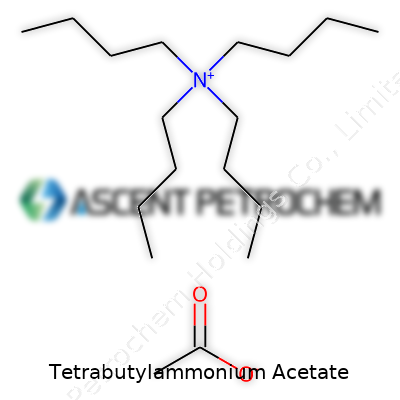
Tetrabutylammonium Acetate carries the chemical formula C16H35N.C2H3O2. That’s a mouthful for what looks like a regular white powder if you see it in the lab. Take apart the name and what’s inside becomes clearer. The “tetrabutylammonium” part: one nitrogen surrounded by four butyl groups (each butyl containing four carbons and nine hydrogens). That brings us to C16H36N, but the actual cation—the part with a positive charge—drops a hydrogen, so it usually appears as C16H35N+. Flip to “acetate,” which comes from acetic acid and sits as C2H3O2– in this salt.
Tetrabutylammonium Acetate is more than just another compound on the shelf. In many labs, it’s the go-to choice for Phase-Transfer Catalysis. I first met this compound in a college organic chemistry class. Carrying out a reaction between water and oil—metaphorically—called for a “bridge.” Tetrabutylammonium Acetate did the job, yanking ions from the water and getting them into the organic layer.
It’s useful outside the undergraduate lab too. Pharmaceutical chemists use it for making complex drug molecules, particularly for those tricky reactions that don’t work well in plain solvents. The purity it offers matters—a low-purity batch can stall a reaction or muddy experimental results, especially with sensitive syntheses or chromatography steps. A 2018 American Chemical Society review called it “indispensable in modern organic transformations.”
Getting high-quality Tetrabutylammonium Acetate makes a difference. I remember scrambling in a start-up’s tiny lab, sourcing ingredients from three different vendors. It quickly became clear: not every supplier delivers the same grade. Some batches came with trace metals or odd smells—both can wreck a reaction’s yield or purity. Good labs always check documentation—coas, batch numbers, and purity scores—before adding this salt to a mix.
A compound that smooths over complex chemical processes comes with certain risks if handled carelessly. Tetrabutylammonium salts have shown minor toxicity in lab studies and can irritate skin or eyes. Gloves and goggles become second nature for good reason, and a chemical hood does more than just keep fumes down—it limits accidental exposure.
Safety data sheets (SDS) from recognized suppliers give practical guidelines. It pays to keep these within reach, especially if new staff members walk in or anyone tries out a new procedure involving this salt.
Researchers care about consistency, and the chemical industry responds. Regulatory groups such as ISO and USP publish standards so that buyers know what they’re getting. When using Tetrabutylammonium Acetate, I always recommend a closer look at not just the formula, but also the batch-specific analysis. It can save costly troubleshooting and save researchers from going down rabbit holes chasing failed yields.
Tetrabutylammonium Acetate may not grab headlines, but it keeps modern synthesis going behind the scenes. Those pursuing green chemistry are looking for cleaner, safer substitutes. But for now, the practical utility of this salt keeps it at the center of many experimental protocols, with a simple formula anchoring big breakthroughs.
Anyone who works in a laboratory has seen their fair share of strange chemicals, but few get the raised eyebrow that tetrabutylammonium acetate draws. It’s an ionic compound and a staple in organic synthesis. Folks rely on it for phase-transfer catalysis, biological sample prep, and sometimes in NMR studies for its solubility in organic solvents. But this chemical isn’t like table salt or baking soda — handling and storage need a bit more thought.
A white powder sitting on a shelf looks harmless, but things can get dicey with a little moisture in the air. Tetrabutylammonium acetate absorbs water just enough to cause clumping and degradation over time. Anyone checking on a bottle they left a little loose remembers scraping out a cake rather than a free-flowing solid. Past that, prolonged exposure to light may kick-start slow decomposition, turning your prized reagent into an unpredictable mess. If the label’s gone crusty or faded, people start guessing whether it’s still good, which goes against every good lab habit.
My experience says nothing beats basic discipline: keep the lid on tight and take what you need, minimizing how long the bottle stays open. Air humidity creeps in fast, especially on summer days. Storing the bottle in a cool, dry environment makes a world of difference. Many labs stick these bottles in desiccators. I throw a few silica gel packets into the box or storage drawer, since they’re a cheap insurance policy against moisture. Regularly checking those little packets and swapping out spent ones keeps things working longer.
Sunlight can fade a label or even damage the powder, so shelving away from direct sun avoids headaches. In shared spaces, sticking a “Date Opened” sticker on each container lets everyone know its age without digging for paperwork. Labs that sidestep record-keeping usually end up tossing out half-used bottles “just in case,” bleeding money from the grant.
Gloves and goggles aren’t just box-ticking for safety boreds — this stuff will irritate skin and eyes with sloppy handling. Inhaling fine dust from the jar stirs up throat tickles and sneezing fits. Keeping a little scoop or spatula only for this chemical reduces cross-contamination, a lesson learned after mixing things up once and stumbling through the clean-up.
Proper storage isn’t glamorous, but it saves time, money, and ensures that experiments run as planned. Even something as tiny as labeling a jar or screwing the lid on all the way makes a difference. The less drama over a spilled jar or ruined sample, the better everyone’s day goes.
Regulatory sources including Sigma-Aldrich and Fisher Scientific list the same advice: store tetrabutylammonium acetate in tightly sealed containers, away from heat, moisture, and light. The European Chemicals Agency includes it in their Chemical Safety Reports, detailing similar handling instructions. Nothing in the chemical’s profile calls for advanced robotics or complicated systems—just practical, consistent attention.
Smart storage is less about high-tech solutions and more about learned routine. Keep it cool, dry, sealed, and labeled clearly. Encourage good habits among everyone in the lab, whether students or seasoned chemists. From the smallest research space to the largest academic institute, these steps help tetrabutylammonium acetate stay reliable and ready for whatever experiment comes next.
In every lab I’ve worked in, respect for chemicals draws a line between getting home safely and ending up in a bind. Take Tetrabutylammonium Acetate. This stuff shows up in all sorts of organic reactions, making life easier for chemists. Still, every bottle carries risk—one slip in handling and you’re looking at skin irritation or something worse.
A solid set of gloves sometimes feels like your best friend in the lab. Nitrile gloves stand up well to organic salts. Sometimes, latex crumbles or tears way too easily, letting the chemical touch your skin. Safety goggles matter just as much. Anyone who’s gotten a splash near their eye knows how lucky they are to walk away with only a scare. Toss on a lab coat and closed shoes. Clothes that cover as much skin as possible help keep problems on the outside.
Working under a fume hood often feels awkward at first, especially when you’re used to the open bench. Still, moving work involving Tetrabutylammonium Acetate into the hood cuts down the chance of breathing in fumes or dust. Even a little time spent wafting something toxic in a quiet corner adds up after weeks or months.
Good housekeeping rules carry more weight than most people expect. Wiping up spills right away and labeling every bottle saves real headaches. I remember one incident—a mislabelled reagent, left behind by a busy researcher, caused a minor panic before anyone realized what had happened. Neat benches and good communication often mean you spot leaks and spills before somebody gets hurt.
Every chemical has its quirks. Safety Data Sheets (SDS) lay out hazards, show what first aid steps to take, and flag the kind of storage each compound demands. Tetrabutylammonium Acetate rarely causes fires but storing it away from strong oxidizers still makes sense. The SDS reads like a manual for disaster prevention. Any time you work with something new—or something you haven’t touched in a year—spend a minute reviewing it.
Clearing out old chemicals at the end of a research project shows just how easily bad habits develop. Pouring something like Tetrabutylammonium Acetate down the drain doesn’t cut it. Most places have clear protocols for disposal. Calling in the hazardous waste team costs some time, but nobody wants tremors in the groundwater or regulators knocking. In my last university job, ignoring this rule led to fines and shame—it stuck with everyone who worked there.
Few things shake up routine like seeing a colleague exposed to something toxic. Emergency showers and eye wash stations need clear access at all times. Training sessions might feel repetitive but rushing to use a blocked eye wash station wastes precious seconds. In my early years, a simulated spill drill caught us unprepared—the lesson stuck for good.
Tetrabutylammonium Acetate might seem harmless compared to some of the nastier substances out there, but trouble shows up fast for those who cut corners. With clear habits and respect for the risks, labs become safer for everyone. People and communities depend on that kind of responsibility.
Tetrabutylammonium acetate doesn't pop up in everyday conversation, but in research and industrial settings, this compound pulls its weight. Chemists and manufacturers count on clear specs because the tiniest impurity can throw off a reaction or product. What stands behind the label “high purity” isn’t marketing fluff—it's a real commitment to performance and safety.
Anyone who’s handled this reagent knows the importance of purity, not just for yields but for reliability across experiments. When a supplier lists something like >98% purity, chemists actually run tests to confirm that number. Water content gets checked by Karl Fischer titration, while the presence of chloride or heavy metals comes under scrutiny through techniques such as ICP-MS or AA—because nobody wants copper or iron hitching a ride on their acetate. For Tetrabutylammonium acetate, most reputable suppliers post a minimum purity of 98%, and often higher, with limits set for moisture (under 0.5%), and very low halides. Analytical certificates usually support these claims, including HPLC or 1H NMR spectra for batch-to-batch consistency. Quality doesn’t just protect the end-user; it saves time, money, and a lot of head-scratching in troubleshooting.
The typical listed specs often include:
Years spent working with ionic reagents have shown that deviation, even by a fraction of a percent, leads to issues. At times, a batch with slightly elevated moisture content has tanked reaction selectivity or led to stubborn emulsions where none should exist. These headaches cost more than the price of higher purity material.
Dependable suppliers crack this nut by putting every batch through in-depth analysis. Chemists with tight deadlines and limited funding cannot chase down quality issues every time an order lands. Transparent specification sheets and fast responses make a difference. Some labs may carry out additional purification, but not all have the luxury or equipment, so they rely on supplier honesty and robust documentation.
Beyond standard tests, the industry could bring more openness by sharing additional data—like photostability or long-term storage stability reports. Many users would also benefit from expanded impurity profiling, especially when new applications or stricter regulations pop up. Another fix involves improved packaging and clearer expiry dating, since tetrabutylammonium salts don’t always behave the same after a year on the shelf, particularly under humid conditions.
Getting the most from Tetrabutylammonium acetate involves digging into certificates of analysis, asking tough questions when specs seem vague, and giving feedback to suppliers. Lab results and lessons from failed syntheses underline this: high-quality, well-characterized chemical supplies mean fewer surprises, safer work, and better science.