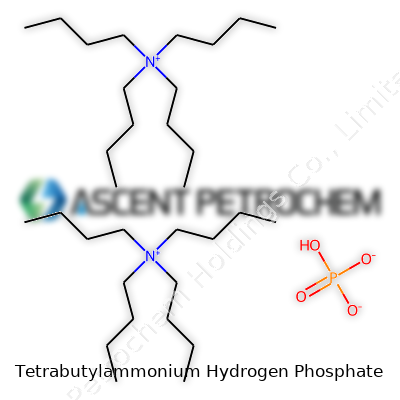
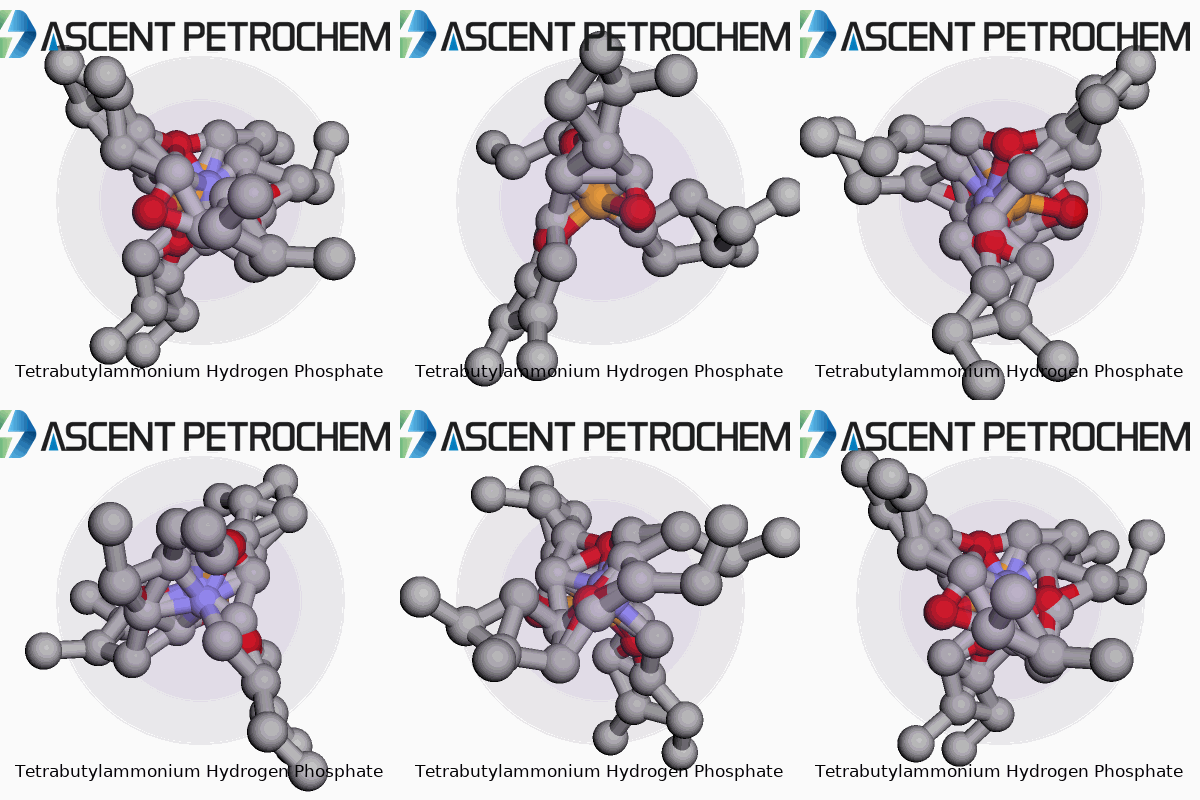
Research into quaternary ammonium salts ramped up in the mid-20th century, as scientists hunted for soluble reagents that could operate in organic chemistry. Back then, moving ions between polar and nonpolar solvents was a challenge. Scientists found that tetrabutylammonium ions, with their hydrocarbon “arms,” solved the problem by bridging water and organic solvents. Tetrabutylammonium hydrogen phosphate emerged from this wave of innovation, joining a family of useful phase-transfer agents. Companies and academic labs in the late 1970s and early 1980s started producing and employing it for both analytical and preparative work, kickstarting its growth within the chemical toolkit.
Tetrabutylammonium hydrogen phosphate stands out for its solubility in organic solvents like acetonitrile and dichloromethane. Unlike traditional phosphate salts, its bulky organic cation means it doesn’t clump up or precipitate, even in tough conditions. Chemists value this trait when they need phosphate functionality but don’t want crystallization gumming up their procedures. The chemical’s white to off-white powder form makes it easy to handle and weigh, easing lab work and scaling to industrial batches. Many suppliers package it in sealed, moisture-proof containers, since it draws water from the air. Over the years, quality control shifted from a focus on appearance and weight to detailed purity metrics, with reputable vendors now providing certificates that document NMR, moisture content, and thermal stability.
With a molecular formula of C16H36NO4P, this salt weighs in around 337 g/mol. Solid at room temperature and prone to absorbing moisture, it feels greasy or oily to the touch after exposure to humid air. Its melting point falls around 150°C, while decomposition kicks in not long after. Notably, the compound dissolves well in solvents like methanol, acetone, and DMSO, giving users a broad solvent window for different setups. Unlike sodium or potassium phosphate salts, it doesn’t conduct electricity in the same way when dissolved, reflecting the large, bulky cation. Its hydrogen phosphate anion brings weak basicity, which can buffer or trap protons during catalytic cycles.
Vendors typically ship this compound with labeling that specifies assay percentage (usually >98%), accompanying water content, chloride and sulfate impurities, and recommended storage conditions (well-sealed, desiccator, room temperature). Certified reference materials often come with lot numbers, production dates, and safety hazard reminders in case of skin or eye contact, following international chemical safety guidelines. Labels also give both the systematic name and the commercial trade name, helping users track regulatory requirements for hazardous materials.
Lab chemists usually prepare tetrabutylammonium hydrogen phosphate by neutralizing tetrabutylammonium hydroxide with phosphoric acid. The process uses anhydrous conditions to avoid introducing water, which would complicate crystallization and purity. The resulting solution is concentrated under reduced pressure, driving off solvents before the product solidifies out. The solid is washed with cold diethyl ether to remove leftover organics, then dried under vacuum. This approach delivers high purity and avoids the presence of sodium or potassium, which can interfere in later uses.
Its main strength lies in transferring phosphate ions into non-aqueous environments. Chemists use it to run phosphorylation reactions on organic molecules or to promote certain alkylations and Michael additions. The bulky tetrabutylammonium cation resists further modification, but the molecule can participate in metathesis reactions, swapping out the hydrogen phosphate anion for others as required. Some labs explore further derivatization of the phosphate group, attaching labels or tags for analytical chemistry, especially in NMR or mass spectrometry-based techniques.
Over the years, chemical catalogs and regulatory documents have adopted several names: N,N,N,N-tetrabutylammonium dihydrogenphosphate, TBAH2PO4, and tetrabutylammonium phosphate monohydrate, among others. In the lab, most people shorten it to TBA hydrogen phosphate for brevity. When checking compatibility or regulatory status, it pays to compare CAS numbers, since suppliers occasionally rebrand or relabel based on country or region.
Working with tetrabutylammonium hydrogen phosphate, safe handling can’t take a back seat. The compound may cause skin or eye irritation, so gloves and goggles are a must. Moist environments can accelerate decomposition, so storage in airtight jars and dry cabinets may save expensive inventory from spoiling. Material safety data sheets address thermal decomposition products, which can include toxic fumes like triethylamine or phosphorus oxides, especially if heated above its melting point. Disposal needs compliance with local hazardous materials guidelines, since the parent compound and any byproducts can threaten water treatment processes if discarded improperly.
Chemical synthesis and drug discovery represent some of the largest users of this salt. The compound's ability to act as a phase transfer catalyst speeds up reactions involving phosphate ions, a fragrant contrast to sluggish, aqueous-only processes of the past. Analytical chemists draw on it to prep samples for NMR, where non-aqueous conditions matter. Electrochemistry and battery development have also begun to harness its properties, since tetrabutylammonium salts bring stable, non-reactive cations that help test new electrode materials. Companies working in organic electronics and sensor design find its solubility and charge transport capacity useful for device optimization.
Recent research in organophosphorus chemistry shows that tetrabutylammonium hydrogen phosphate can unlock tricky reaction pathways inaccessible with conventional reagents. During my graduate years, colleagues often mentioned the difference in yields between conventional sodium phosphate and this bulky "organic" alternative. Scientists at university labs keep seeking new ways to employ the reagent in selective mono- and di-phosphorylation events, which help create targeted prodrugs or specialized ligands. Computational chemists, meanwhile, analyze ion-pairing and solvent effects, since the flexibly shaped cation influences solubility and reaction kinetics beyond what simple ionic theory might predict.
Studies of tetrabutylammonium hydrogen phosphate point out that, like many four-alkyl ammonium salts, it can disrupt membranes in aquatic organisms. Toxicological evidence remains limited, but preliminary work in zebrafish suggests caution with wastewater streams. Chronic exposure hasn’t been linked to significant health effects at low concentrations for humans, but lab rules recommend minimizing inhalation or ingestion, given the possible cumulative effects. Occupational health agencies set exposure guidelines in the low ppm range, erring on the side of worker safety.
Tetrabutylammonium hydrogen phosphate’s best days likely still lie ahead. As researchers keep refining organic-inorganic hybrid materials, demand for customizable phosphate sources keeps climbing. Green chemistry initiatives search for solvents and reagents that cut down on wasted byproducts, and this salt helps by enhancing selectivity and reducing water footprints in synthesis. Biotechnology and diagnostics look promising as new frontiers, since modern analytic instruments need mobile ions in mostly nonpolar settings, where this compound does its best work. Investment and collaboration between academic and industrial labs set the stage for smarter, cleaner, and safer chemistry with tetrabutylammonium hydrogen phosphate as part of the next generation toolbox.
I remember the first time I started working in a chemistry lab. Bottles with intimidating names lined every shelf. Tetrabutylammonium hydrogen phosphate felt like a tongue-twister, but behind the label stood a workhorse many researchers rely on. This salt might sound obscure, but it pops up in labs all over the world for pretty good reasons.
Organic chemists use tetrabutylammonium hydrogen phosphate for phase-transfer catalysis. Transferring substances that wouldn’t normally mix is always a headache. Oil and water don’t want to work together — but plenty of chemical reactions need both at the same time. Here, a phase-transfer agent steps in. Tetrabutylammonium hydrogen phosphate helps lift certain molecules, like anions, from one layer into another. That way, solutions get to interact and react, instead of sitting in isolation. Reactions that used to crawl suddenly move much faster.
This compound goes way beyond just shuffling ions in a flask. Tetrabutylammonium hydrogen phosphate supports enzyme work in labs. Some enzymes can lose their effectiveness if the environment shifts even a little. Researchers noticed that adding specific salts, like this one, can stabilize enzymes. More stable enzymes mean more reliable results, especially in research or industrial processes where time and money run tight. Studies over the past decade back this up, showing better enzyme activity and lower risk of breakdown in the presence of tetrabutylammonium salts.
I’ve seen a real push in the chemistry field for reactions that avoid harsh or polluting chemicals. Cleaner methods matter now more than ever, thanks to mounting pressure for greener labs. Tetrabutylammonium hydrogen phosphate often steps into greener synthesis, where it can help reactions run efficiently without toxic metals or solvents. Articles in journals such as Green Chemistry discuss improved yields and selectivity when using this compound as a catalyst or ion transporter.
No chemical is perfect. Like many quaternary ammonium salts, tetrabutylammonium hydrogen phosphate calls for cautious handling. Direct contact irritates skin and eyes, and long-term exposure raises concerns for aquatic life. Labs weigh these risks carefully, sorting spills, gloves, and disposal methods. The environmental impact, especially regarding water systems, deserves more research. Some companies develop ways to recycle the catalyst, or neutralize leftover materials safely, to ensure the benefits don’t come at a hidden cost.
Plenty of synthetic routes and analytical processes lean on quality chemicals. Tetrabutylammonium hydrogen phosphate, even with its unwieldy name, proves how a single compound can do heavy lifting in research and industry. Reliable reagents set foundations for everything from medicine to biofuels. As labs work towards safer practices and greener results, understanding the strengths and limitations of these chemicals becomes essential. Talking openly about safety and sustainability leads to better science and better outcomes for everyone.
Tetrabutylammonium hydrogen phosphate sits on many chemistry shelves. Students and researchers often reach for it during syntheses, extractions, and chromatographic separations. Its chemical formula, (C4H9)4N H2PO4, is more than a collection of letters and numbers. It unlocks the compound’s structure and guides anyone who handles it, from order to disposal.
In the lab, this salt stands out for its ability to shuttle ions back and forth. I’ve relied on it to tweak the performance of buffer systems in liquid chromatography. The tetrabutylammonium cation offers bulk, dong the job of a phase-transfer agent, while the hydrogen phosphate anion brings its own set of behaviors—especially regarding pH control and buffering in aqueous systems. This mix shapes how pharmaceuticals are purified or how environmental samples get analyzed with pinpoint accuracy.
The right chemical structure changes everything. Sometimes a molecule off by one hydrogen can ruin an experiment or, worse, put a project months behind. Chemical catalogues sometimes look like arcane lists full of jargon, but this basic knowledge helps labs avoid cross-contamination, ordering mistakes, and wasted time. Tetrabutylammonium hydrogen phosphate, with that exact formula, ensures that what’s in the bottle works in the reaction vessel. Trust in this formula goes a long way in clinical research, drug analysis, and standard-setting labs. The facts matter—wrong materials lead to skewed data, which sets back whole teams.
Mistakes aren’t just academic, and I’ve seen talented researchers puzzle over reactions that refuse to proceed, only to find that an error in the stock compound started the trouble. The cost of this: lost hours, wasted money, sometimes a full batch of analysis to repeat. Regulatory labs bear the brunt as well, where strict documentation demands every formula line up. Human health studies can’t afford off-brand substitutes. Safety protocols and data integrity depend on clarity. Anyone using a close variant, like the dibasic or tribasic forms, or the chloride instead of the hydrogen phosphate, can’t just swap them in and hope for the best.
Supporting precision starts at the shelf. Every lab technician should double-check labels before use, and digital inventory systems, while not flashy, cut down on missteps. Regular training matters, especially as interns and new hires cycle through. Digital databases such as PubChem and Sigma-Aldrich provide reliable backstops, listing everything from molecular mass to solubility, ensuring teams access trustworthy references. Trusted vendors, certifications, and documented batch analysis reports each help underpin the authenticity of compounds. An organized, up-to-date chemical logbook isn’t just tidy—it becomes a lab’s safety net.
I’ve seen partnerships with reputable suppliers make a difference, especially during audits. Cross-checking between the order sheet and chemical received becomes second nature with practice. Sharing knowledge—about why formulas like (C4H9)4N H2PO4 matter—means fewer preventable errors. Upgrading protocols, even as simple as asking everyone a quick “What’s the formula?” before starting, sets the right tone in the lab. This culture of care sets up teams to make real progress—one formula at a time.
Tetrabutylammonium hydrogen phosphate pops up often in research labs, especially in organic synthesis or as a phase transfer catalyst. Over the years, I’ve seen plenty of accidents caused by ignoring basic storage guidelines for chemicals like this one. Keeping chemicals stable starts with respecting their properties, not just following a manual out of habit.
Even though tetrabutylammonium hydrogen phosphate doesn’t explode under normal lab conditions, it still deserves careful handling. Skin contact may cause irritation. Dust can bother the lungs and eyes. Once, a coworker picked up an unmarked bottle, not realizing poor storage led to leaks, and ended up with a mild burn. The lesson? Always keep chemicals in labeled, tightly sealed containers, away from direct sunlight and heat. Simple habits prevent a lot of hassle.
No chemical storage method lasts if staff turnover strips away institutional memory. An hour-long orientation every few months helps everyone pick up on the routines: close the lid, check labels, watch for expiration dates. Everyone’s job gets easier when you don’t question what’s in your cabinet.
I recommend setting up routine checks every quarter. Walk through shelves, making sure lids are secure and no powder dust collects on surfaces. Supervisors who show up for these checks set the right example—students and staff quickly learn that safety isn’t just paperwork.
If a bottle sits for years or looks suspicious—caked residue at the mouth or moisture inside—don’t risk using it. Follow local hazardous waste protocols. Dumping this kind of chemical into the drain has triggered fines in labs I worked in, especially with environmental services tightening up oversight. Document every disposal; digital logs or even a notebook work, as long as details like date and amount leave nothing to guesswork.
Safe storage means adapting as new information comes out. Most chemical suppliers update their safety data sheets regularly. A team that checks these updates stands a better chance of preventing incidents. Open conversations in team meetings find gaps in routines before regulators or inspections do.
Years around labs have taught me that storing tetrabutylammonium hydrogen phosphate safely isn’t about fear—it’s about respect. Small steps pay off, making science safer, smarter, and more sustainable.
Tetrabutylammonium hydrogen phosphate shows up in a wide range of laboratories, from research universities to industry testing sites. It acts as a phase transfer catalyst and helps make complex chemical reactions a lot easier. Most people working with chemicals eventually run across it, especially in organic synthesis classes or professional labs. The name alone sounds intimidating, which makes sense because it isn't your average kitchen ingredient.
I remember the first time I worked in a chemical prep room, watching the bottles get wheeled out by people in gloves and goggles. That’s not just for show. Many chemicals, including tetrabutylammonium hydrogen phosphate, can harm your body if handled carelessly. Direct skin contact can trigger irritation. That stinging, itching sensation that comes after an accidental spill—it’s not something you forget quickly. Breathing in powder or dust adds another layer of risk, as the compound may damage your lungs or cause coughing and burning in your throat.
This chemical includes both an organic cation and an inorganic phosphate. The organic part makes it more likely to cause irritation compared to simple salts you might find under your kitchen sink. Tetrabutylammonium compounds aren’t known for causing cancer or mutating genes, but they aren’t exactly benign, either. Extended or repeated exposure can harm internal organs, especially the liver and kidneys. Environmental risk matters too: If this stuff spills down the drain, local aquatic life can experience the toxic effects for days.
Years ago, while working with graduate students in the chemistry lab, I noticed that complacency starts to creep in with familiar compounds. Gloves come off, lab coats get left behind, labels fade. This isn’t just bad form—it creates real risks. Safety experts and chemical suppliers keep emphasizing the basics for a reason. Use a fume hood. Wear goggles. Gloves aren’t an accessory; they’re basic gear. Spills should be handled right away with absorbents designed for chemical waste—not the nearest paper towel.
According to recent Safety Data Sheets, disposal makes a big difference. Pouring a bottle down the sink or into regular trash creates all sorts of hazards for waste workers and the water supply. Chemical waste bins and proper hazardous material pickup services seem inconvenient in the moment, but it’s the only safe way to prevent wider contamination.
Sometimes change starts with a simple conversation. Lab managers can keep sharing real-world accident stories, not just rules from the safety manual. Universities could show short videos of genuine chemical mishaps, so the risks feel less abstract. Anyone handling tetrabutylammonium hydrogen phosphate should keep up with refresher courses and updated safety protocols, even after years of experience.
By supporting a culture that values care and respect for every chemical, everyone involved in chemical handling—students, workers, managers—protects themselves and those around them. Tetrabutylammonium hydrogen phosphate can serve research and development well, but only if safety sits at the center of the conversation.
Working with tetrabutylammonium hydrogen phosphate brings back those long afternoons in the university lab, hunched over beakers, squinting at the cloudy mixture that just wouldn’t go clear. Anyone trying to run phase-transfer catalysis or ionic liquid synthesis might run into the same puzzle: where does this salt really dissolve? Does it just clump up, or will it finally disappear in the next solvent you pour in?
Tetrabutylammonium salts often behave unpredictably in water. Some dissolve fairly well; others stay behind, undissolved, like a stubborn bit of chalk. The hydrogen phosphate version isn’t a fan of plain water. With those big butyl groups sticking out like greasy tentacles, the molecule shrugs off water molecules, so it won’t fully dissolve at room temperature. It’ll disperse and form a cloudy mixture, but don’t expect to read your lab notebook through the glass. If you’re trying to run reactions in water, this can complicate a simple afternoon into a multi-step chase for the right conditions.
Now, if you swap water for an organic solvent like acetonitrile, dimethyl sulfoxide (DMSO), or methanol, tetrabutylammonium hydrogen phosphate shows a kinder face. Those bulky organic groups on the cation kick into action. In acetonitrile or DMSO—a pair of solvents that many folks keep on the ready shelf—this salt becomes much more soluble. It’s because organic solvents interact better with butyl chains, wrapping themselves around and encouraging the crystal lattice to break apart. Suddenly, that cloudy mixture clears, letting you go on with your NMR spectroscopy or complex ion pairing studies without a hitch.
Chemists have a saying: "dissolve it or lose it." If your compound refuses to make friends with the solvent, the whole experiment stalls. I’ve watched good reagents turn useless because they wouldn’t dissolve where I needed them. That’s doubly true in electrochemistry or catalysis, where mobility matters. Tetrabutylammonium hydrogen phosphate offers a great balance—if you pair it with the right organic medium.
Mixing solvents can help. A dash of water in methanol—or a hint of DMSO in acetonitrile—sometimes does wonders. Some research papers back this up, showing increased solubility and better results in mixed media. The trick is patience and trial, feeling your way through combinations until the salt vanishes. Pre-warming the solvent and stirring can bump up solubility further.
Every solvent that dissolves this salt comes with its own safety notes. Methanol fumes aren’t pleasant, DMSO carries almost anything through skin, and acetonitrile asks for solid ventilation. I’ve seen colleagues gloss over safety sheets, only to regret it later. So, keep bottles tightly closed and work in the hood. Tetrabutylammonium salts are not especially volatile or hazardous, but the solvents deserve respect.
Peer-reviewed databases and technical sheets from trusted chemical suppliers help settle the debate about solubility ranges. I check data from Sigma-Aldrich or Merck, not just online forums. Researchers report solubility of tetrabutylammonium hydrogen phosphate in the range of 0.1–0.5 M in acetonitrile and DMSO—enough for most synthetic or analytical work.
If you’re eyeing up tetrabutylammonium hydrogen phosphate for any synthesis or extraction, ditch water for acetonitrile or DMSO. Mix with care, trust official data more than hearsay, and keep your gloves on. The right solvent turns a tough compound into a reliable partner, helping you get back to what matters—solid results and a smooth workflow.