The journey of Tetramethylammonium Fluoride (TMAF) spans back to the years when chemists hunted for stable sources of fluoride ions that did not involve handling sticky, corrosive gases or hydrofluoric acid. Back in the mid-twentieth century, organoammonium salts started creeping into the mainstream as researchers saw the potential in pairing organic cations with reactive anions like fluoride. TMAF emerged as a standout, kind of a poster child for quaternary ammonium salts doing useful chemistry in organic synthesis, especially where clean, anhydrous fluoride sources were in short supply. Word of TMAF spread across university chemistry labs and industry workbenches, where it appeared in reaction schemes and patents, building a legacy as more than just another niche compound.
Today, TMAF mostly arrives in labs as a white, crystalline powder. Chemists rely on it as a handy alternative to naked fluoride ions for specific deprotection reactions and nucleophilic substitutions. Its physical form and the ease of shipping compared to other fluoride sources mean it gets a spot on chemical supplier lists across North America, Europe, and Asia. For anyone trained in chemistry, seeing tetramethylammonium fluoride on a reagent shelf is almost like spotting a useful tool waiting to solve a stubborn synthetic problem.
With the empirical formula (CH3)4NF, TMAF stands out for its high solubility in polar, aprotic solvents like DMSO and acetonitrile. Its hygroscopic nature—drawing water from the air before you can blink—means any careless handling quickly ruins its effectiveness for moisture-sensitive syntheses. Chemists have measured its melting point in the ballpark of 130-140°C, and in solid form TMAF does not emit fumes or smell, making it more approachable than acid-based fluorides. The compound dissociates in solution to release 'free' fluoride ions, which pack a hefty punch as a nucleophile, but it won't go on any wild magic by itself without the right partners and conditions.
Commercially available TMAF often comes listed as the anhydrous version, but suppliers also sell hydrate forms, and these variations really do matter for certain transformations. Labels from reputable vendors spell out the purity levels—typically above 98% for research and above 99% for high-stakes synthesis. Detailed safety data sheets (SDS) explain both the hazards of fluoride and the relatively low volatility of the tetramethylammonium cation. Chemists will find warnings about keeping TMAF dry, using gloves, and handling inside a fume hood, which matches both good lab practice and compliance with regulations tied to hazardous substances.
Standard preparation routes for TMAF start with tetramethylammonium hydroxide reacting against a soluble fluoride salt, most often hydrofluoric acid or a fluorinated silane. Careful exclusion of atmospheric moisture turns out to be crucial at this stage. Precipitation, drying under vacuum, and purification steps ensure that the product doesn't come preloaded with water, bicarbonate, or carbonate contaminants. In some academic labs, folks will prepare small batches as needed to dodge the storage problems associated with highly hygroscopic salts. The quality of the preparation shows clearly—if you get a sticky, clumpy mess instead of a dry powder, it's time to start again.
Chemists love TMAF for one reason above all: it opens the path to fluoride-based deprotection reactions without dragging along the hazards of caustic or liquid HF. In silicon chemistry, TMAF knocks off silyl protecting groups from alcohols, phenols, and acids, letting the underlying functional group shine. The action runs clean in many common solvents under mild conditions, freeing up the chemist from wrestling with nasty acids or dealing with glass-etching side reactions. Beyond deprotection, TMAF acts as a fluoride donor in making organofluorine compounds, sometimes driving the fluorination of aromatic rings or the conversion of chlorides to fluorides. Some chemists experiment with using TMAF in ionic liquids or phase-transfer catalyzed systems, seeking improvements in yields and selectivity that would otherwise demand harsher reagents.
Trade catalogs reveal TMAF under several names. You might spot it listed as tetramethylammonium fluoride, TMAF, N,N,N,N-tetramethylammonium fluoride, or just the shorthand “TMA fluoride.” Industry discussions mention product codes, batch-specific numbers, or variations denoting degree of hydration: TMAF hydrate, TMAF trihydrate, or anhydrous TMAF. It’s easy to see how the name can shift slightly to emphasize technical particulars or regulatory registration, especially in global supply chains.
Handling TMAF safely means more than following the basics. Direct skin exposure, inhalation of dust, or accidental ingestion can trigger systemic fluoride exposure, which presents genuine health risks if ignored. Fluoride salts deserve genuine respect for their toxicity, not just for their nuisance as reagents that coat everything with invisible powder. Lab teams getting the most out of TMAF use closed transfer systems, proper PPE, and keep calcium gluconate gel on hand as a measure against potential fluoride exposure. In industry, strict adherence to chemical hygiene rules cut down on incidents and keep both people and product safe. Waste disposal follows rules for both fluoride and quaternary ammonium salts, since careless dumping leads to environmental persistence and water treatment headaches down the line.
TMAF shows up most often in synthetic organic chemistry, especially where selectivity in the removal of protecting groups means the difference between a successful compound and a failed experiment. Medicinal chemists and pharmaceutical process teams rely on TMAF for steps in the assembly of complex molecules, particularly for late-stage editing where milder fluoride conditions pay off. Silicon-based materials research borrows tricks from small-molecule chemistry, using TMAF for siloxane manipulations, etching, or surface cleaning. Analytical labs sometimes use TMAF for sample preparations that demand thorough degreasing or deprotection without resorting to mineral acids. The adoption in research settings often tracks with local experience—labs using silicon protecting groups tend to swear by their favorite batch of TMAF, and the reputation for clean workups keeps demand steady from university teaching labs to industrial-scale synthesis lines.
Recent years have brought new attention to both the chemistry and handling of TMAF, especially as safer or more environmentally benign fluoride sources creep to the top of research priorities. Chemists continue probing the fine details: what solvent systems offer the highest yields, whether solid supports can tame the hygroscopic heartache, and how to recycle fluoride byproducts for waste minimization. TMAF’s influence stretches into more specialized studies around green chemistry, where folks mix it with room-temperature ionic liquids to try new solvent systems. Teams in academic labs test modified ammonium cations and multicentric fluoride donors, hopeful that tweaks to structure can balance reactivity, stability, and waste. In the patent literature, TMAF shows up frequently as both a reference compound and a launching pad for safer alternatives, often spurring innovation among companies eager to edge out competitors with a better process or greener footprint.
Research into the toxicity of TMAF breaks in two directions. Toxicologists study the effects of acute and long-term fluoride exposure, mapping the limits before systemic toxicity or chronic bone damage develops. Animal studies and cell culture models confirm that TMAF releases bioavailable fluoride, and with enough exposure, all the classic signs of fluoride poisoning can emerge—nausea, vomiting, even cardiac issues if it gets out of hand. Most chemists never hit those doses, but the potential for skin burns and tissue necrosis with local overexposure means risk remains real on the benchtop. Regulatory bodies, including the EPA and similar agencies in Europe and Asia, assign strict limits for occupational exposure and enforce monitoring where TMAF gets used in sizeable quantities. For chronic effects, researchers point to slightly more nuanced outcomes, where fluoride’s famous tenacity in bone and tooth mineral fades into possible risks for enzyme inhibition and electrolyte imbalance if people get exposed repeatedly. Control, caution, and up-to-date training help balance the benefits in chemical synthesis with the hazards tied to fluoride ingestion or chronic exposure.
TMAF holds a strong place in the toolkit of chemists searching for reliable sources of free fluoride ions. Looking ahead, the pressure to create greener, less toxic alternatives will likely spur both incremental improvement—such as less hygroscopic analogs or buffered preparations—and disruptive innovation, including switchable solvents or safer, biodegradable fluoride donors. Teams in applied research might focus on designing TMAF-based systems that deliver precise reactivity while limiting environmental or health risks, potentially opening the door to broader adoption in semiconductor fabrication or biochemical modification. Experiences in my own lab remind me that practicality wins out most days; the future of TMAF will rest on the community’s insight and ability to keep tough chemistry accessible, safe, and open for the next wave of discoveries.
Tetramethylammonium fluoride, often called TMAF, shows up in labs where chemistry meets technology. Folks in organic synthesis lean on it for one key job—removing silyl protecting groups. Chemists protect certain parts of a molecule so other bits can be changed or built upon, then use TMAF to strip away that protection. TMAF beats older choices like tetrabutylammonium fluoride in some cases thanks to its solubility and strength. On a bench with dozens of glass vials, it’s a go-to for reactions that call for a swift, sharp fluoride source.
In the microchip world, every detail matters. Small molecules like TMAF play big roles in making sure etching and cleaning steps go right. Cleaning silicon wafers demands fluoride in a reliable form. TMAF, dissolved in organic solvents, helps remove stubborn residues that could wreck a batch. When the goal is pure, functional hardware, choosing chemicals with proven records—TMAF included—makes a difference between wasted effort and working circuits. Chip engineers and chemical suppliers talk about purity and safety in the same breath. Failures in this stage add up to millions lost and delays for everything from computers to cars.
Working with TMAF does not feel like mixing sugar and water. It’s toxic. Skin burns, respiratory damage, and even fatal accidents have been reported. Getting careless in handling leads to exposure nobody wants. I’ve walked through labs wearing gloves and goggles, knowing spills with this reagent call for quick, steady hands and strong safety procedures. Emergency showers and well-stocked first-aid kits give a sense of security, but real safety lives in habits and respect for the risks.
The material safety guides lay out the cold facts: TMAF reacts with water to release methylamine and other gases. Inhale those fumes or mishandle the powder, and blows to health add up quickly. Stories of accidents spread through the science world, often as warnings more than headlines on the evening news.
Consumers rarely hear about TMAF. That doesn’t make its impact any less real. Electronics, pharmaceuticals, and new materials often owe part of their existence to chemicals like this one. If the push for smaller, faster devices continues, safe handling and thoughtful disposal deserve more discussion.
Poor chemical disposal shows up in groundwater tests and news about contaminated rivers and soil. Companies caught cutting corners earn more than a fine—they find their reputations stained, and the public pays for the cleanup. In my own work, I've seen responsible labs invest in fume hoods, air monitors, and staff education. It’s usually the quiet, ongoing effort that prevents bigger disasters.
Safer alternatives keep popping up on the market. Green chemistry pushes everyone toward options with fewer hazards and easier waste management. Finding chemicals that work can’t come at the cost of safety or damaged ecosystems. Real progress means teaching every new researcher exactly what these materials do, how they harm, and how the right decision up front spares headaches later.
TMAF won’t grab headlines, but its presence runs beneath a lot of what we call modern progress. The challenge? Never forgetting who and what stands to gain—or lose—from the shadows behind each high-tech leap forward.
If you’ve ever handled reagents in a lab, you know a sloppy storage setup invites trouble. Tetramethylammonium fluoride (TMAF) brings its own brand of risk. It doesn’t act like sugar or salt you can leave on a shelf. With TMAF, improper conditions lead to moisture sneaking in, dangerous fumes filling the air, or sometimes even a runaway chemical reaction. Chemists figure out pretty quickly that not every compound plays nice. TMAF's toxicity and reactivity make it something you treat with respect. Mild carelessness can send someone to the emergency room or kill a sensitive experiment.
Most bottles of TMAF arrive snug inside air-tight containers for a reason. Exposed to air, the powder absorbs water in no time and forms a caustic solution. Not only does this hurt the chemical’s quality, it speeds up decomposition. That water molecules infiltrate is not just theoretical—after years working with fluoride salts, I’ve seen freshly opened bottles turn damp and clumpy within minutes on humid days.
Harvard’s chemical storage guidelines recommend using gloveboxes or sealed desiccators when handling TMAF, not because it’s tradition, but because people learned the hard way what exposure costs. For long-term storage, TMAF belongs in an airtight jar, with desiccants close by to suck up stray moisture. Forget to close the lid tightly, and you risk a mess of dangerous waste and ruined product.
It helps to give TMAF a cool home. Most suppliers—and my own mentors—suggest a stable place below room temperature, but not cold enough to freeze the container or cause condensation. In the wild swing of temperature from a lab bench, decomposition accelerates, and volatile byproducts start to build up. I’ve seen a freezer shelf packed with desiccated chemicals, each labeled, each with a warning to keep away from open flames and acids. TMAF fits right among those bottles. The lower temperature slows down any reactions that still might kick off, certainty in a setting where uncertainty can spell danger.
Pairing TMAF with acids creates hazards you’d rather read about than experience firsthand. The reaction releases toxic methylamine and volatile quaternary salts, both severe respiratory hazards. In busy labs, it pays to store TMAF on a dedicated shelf, far from acids, oxidizers, and oxygen sources. It’s best to keep strong bases apart too, in case of unexpected mixing. Many chemical mishaps trace back to careless shelf arrangements, not wild accidents.
The lab culture I learned in drilled home the lesson: group by chemical type, double-check the storage codes, and never improvise storage at the end of a long day. Industry guidance, like the Sigma-Aldrich MSDS for TMAF, insists on this separation because overlapping incompatible materials has caused costly evacuations and health scares.
My early days as a graduate researcher taught me patience and fussiness—they paid off each time a storage container stayed bone-dry and ready for safe handling. Thoughtful storage of TMAF isn’t paranoia; it’s common sense. Respecting basic principles—seal against air and moisture, avoid heat, segregate from acids and other threats—sidesteps many emergencies before they can start.
For anyone working in a shared lab, a simple habit of labeling, sealing, and separating chemicals works far better than hoping for the best. Reliable storage for TMAF doesn’t just keep samples pure; it keeps your colleagues safe, and your experiments trustworthy.
Tetramethylammonium fluoride isn’t a chemical you see outside of a lab or industrial setting. It catches the attention of anyone working with it because of how dangerous it can be if handled carelessly. The compound packs a punch for such a small molecule, and it deserves respect in any workspace.
The story starts with its structure—tetramethylammonium as a cation and fluoride as an anion. Both parts contribute to the risks. Anyone working with fluoride compounds knows they bring serious health consequences if they get into the body. With fluoride, there’s the immediate risk of burns and internal harm if it’s absorbed through the skin, inhaled, or ingested. But tetramethylammonium takes it up a notch. It acts as a neurotoxin, which means it can mess with nerves, heart, and muscles. Even tiny doses can cause tremors, convulsions, and in severe cases, can stop the heart.
Chemistry professionals become familiar with the dangers through safety training and firsthand stories from colleagues. I still remember a chemistry professor pausing before demonstrating with a fluoride salt, double-checking his gloves and reminding everyone of a well-known accident at another university. Safety goggles only go so far when a substance can pass through gloves and skin within seconds.
No one wants to reference clinical reports showing fatalities, but facing those facts is part of building trust and understanding. Medical literature highlights cases where accidental skin exposure or inhalation of tetramethylammonium fluoride sent chemists and lab workers straight to the emergency room. Nausea, muscle spasms, respiratory problems—these aren’t hypothetical risks. Without rapid medical treatment, exposure can turn deadly.
Labs across the world try to cut corners to save time or money. But in practice, rushing any step dealing with this compound is asking for trouble. Standard gloves and basic ventilation often don’t offer enough protection. I’ve watched coworkers fumble for answers during safety drills, later realizing that guesswork and assumptions have no place when transferring chemicals like this. Every year, industrial accident reports underline this message with sobering examples of what can go wrong.
Personal experience and the collective wisdom handed down in the scientific community point to strict habits as the answer. High-quality gloves—think nitrile or neoprene, not latex—and face shields form the first line of defense. Reliable chemical fume hoods mean you don’t breathe in vapors. Emergency showers and eyewash stations must be steps away, not down a crowded hallway. Quick access to calcium gluconate gel or other medical treatments for fluoride exposure can make all the difference in an emergency room outcome.
Education stands out as the strongest shield. Lab managers and researchers should insist on regular safety seminars, simulate emergency scenarios, and take reports of symptoms seriously, no matter how mild. Posting up-to-date safety data sheets and making them required reading for all staff sets a standard everyone benefits from. I’ve seen the difference when teams train together: mistakes drop, and the confidence to handle emergencies goes up.
Tetramethylammonium fluoride has no place outside of controlled, trained hands. Disposal needs as much care and planning as use. Regulatory agencies expect strict documentation for every step—from ordering to final neutralization—because the risks stretch far beyond personal health and reach into environmental safety. Places that invest in strong protocols rarely make the news for all the wrong reasons.
The honest takeaway is that danger doesn’t mean avoidance—just full respect. In science, as in life, we’re responsible not just for ourselves, but for those who come after us. That’s a lesson that holds true every time a chemist puts on gloves and prepares to measure out even a tiny bit of something with a toxic bite.
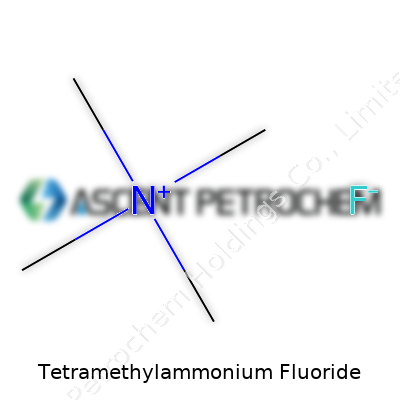
Most chemists know tetramethylammonium fluoride for its utility in organic synthesis. Strip down its long name and you get something simple: a molecule with four methyl groups attached to a nitrogen atom, paired up with a fluoride ion. The chemical formula goes like this: (CH3)4N⁺ F⁻. In short, it’s C4H12NF. This combination looks basic, but it wields significant influence in chemical laboratories.
In real terms, the tetramethylammonium part acts like a bulky, friendly cation. The fluoride anion, known for its high nucleophilicity, makes this salt quite powerful in organic chemistry. This duo creates a strong reagent for removing silyl protecting groups. In other words, it strips away certain chemical shields, letting reactions progress or molecules reveal their reactive edges.
My days in the lab taught me that a missed subscript or a swapped element leads not just to academic mistakes, but to blown reactions, wasted time, and even unsafe situations. Tetramethylammonium fluoride illustrates how a simple formula—C4H12NF—packs specific information: four carbon atoms, twelve hydrogens, one nitrogen, and one fluoride. Every chemist or student gets tripped up at some point, but attention to detail saves money, reputation, and health.
You’ll find the pure salt as a hygroscopic, white solid. It absorbs water from air and forms a strong base when dissolved. Mishandling means unexpected reactions or exposure to corrosive fluoride, which can pierce skin and bones. Gaining experience means knowing not just the formula, but how it behaves. Quick story—years ago, a colleague ignored the material safety data sheet and ended up with minor chemical burns after a spill. No chemical formula can account for personal choices, but taking them seriously changes everything.
Chemists count on tetramethylammonium fluoride for precision. It breaks silyl ethers cleanly, helps with methylation, and sometimes acts as a fluorinating agent. It’s no wonder big pharma and academic labs value such reagents for synthetic routes that require gentle, selective deprotection steps.
Making sure that everyone in a lab recognizes the full chemical formula reinforces trust and safety. Misunderstanding leads to occupational hazards and derails planned experiments. I have seen graduate students confuse this salt with other quaternary ammonium fluorides, costing them precious material and slowing their progress.
Better lab practices and continued education prevent most hazards tied to tetramethylammonium fluoride. The chemical formula, C4H12NF, acts as shorthand for a complex, reactive substance. Sharing accurate information and supporting new researchers nurtures a safer, more productive environment. Precise communication—spelled out in both formulas and safety guidelines—keeps the field moving forward.
Tetramethylammonium fluoride, or TMAF, is a compound I've only seen a handful of chemists trust without a heavy dose of respect. This chemical packs a real punch. It can release toxic fluoride ions, which brings trouble fast if it gets on skin, in eyes, or is accidentally inhaled. No one should try working with it in a poorly ventilated space or without understanding what's at stake. I remember an incident during my university days, when someone mishandled a fluoride compound, and the seriousness of the medical response never left me. Exposure can burn, irritate, and even shut down organs if enough is absorbed.
People talk about lab safety and sometimes gloss over what the right gear really means with chemicals like TMAF. I believe in heavy-duty nitrile gloves rather than cheap latex, since fluoride ions break through weaker options in seconds. Face shields give better coverage than goggles alone, since splashes spray wider than you think. A full lab coat and long sleeves give a barrier against droplets—short sleeves belong nowhere near this stuff. Closed shoes, nothing open-toed, complete the protection. Scientific sources, including safety data from reagent suppliers, agree that these steps save people from life-changing damage.
Chemistry teachers hammered one lesson over and over: respect your fume hood. Not every lab gives each student their own hood, but no one should open, pour, or weigh TMAF outside an enclosure vented to the outdoors. These hoods draw away vapors and dust that can linger for hours and harm anyone passing by. I once saw a careless transfer of a fluoride salt set off the air monitoring alarms, leading to a fire drill and a costly clean-up. The science behind this recommendation stands strong. All major regulatory agencies set exposure limits at extremely low levels for a reason.
I like to double-check container labels—with my own handwriting if possible—so no one has a chance of confusing TMAF with something less dangerous. Transfers should happen in small amounts, avoiding big bottles in case of a slip. Seals should be tight and free from corrosion, since vapor or leaks cause long-term contamination and invisible hazards. Storage in a clearly marked corrosives cabinet, separate from acids and water-sensitive chemicals, keeps disaster at bay. Even a splash of water with dry fluoride can start a chain reaction, releasing hazardous fumes into the air.
I never clear up spills of dangerous chemicals alone. A chemical spill kit, with special absorbing materials and neutralizing agents, makes clean-up much safer than rags or paper towels. I like to keep calcium gluconate gel nearby, since it's the fastest first aid for fluoride burns, though hospital treatment always comes next. Waste goes into dedicated, labeled containers, collected by certified disposal teams. Pouring leftovers down the drain is reckless—traces can corrode pipes and pollute water supplies for whole communities.
No one gets to handle TMAF in a professional lab without training, and home use has no place with reagents this dangerous. I encourage anyone working with hazardous substances to take drills seriously, memorize emergency numbers, and never assume "it won't happen to me." Mistakes can cost more than a ruined experiment—they can mean permanent injury.